
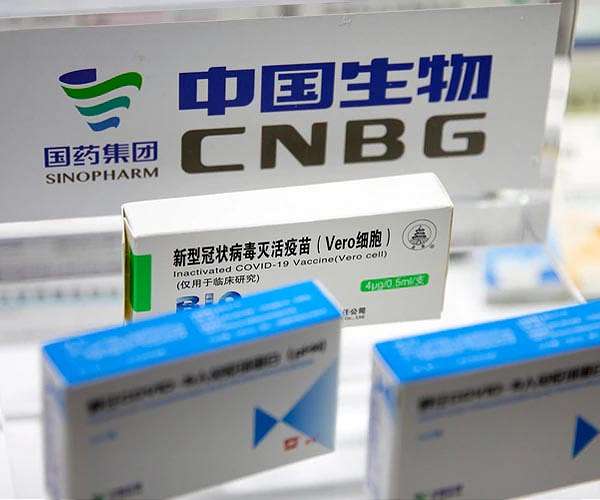
China is poised to ease border restrictions to allow some foreigners — including from the US, India and Pakistan — back in, provided they have taken a Chinese-made Covid-19 vaccine.
The country has been closed to most foreigners since last March to stem the spread of coronavirus which it has largely brought under control at home, stranding many foreigners with jobs and family inside China overseas.
But Chinese embassies in several countries have issued notices saying the country will open visa applications to select people who have taken a China-made jab.
The Chinese Embassy in the US said in a statement dated Monday that it would begin to process "visa applicants inoculated with Chinese Covid-19 vaccines".
This would apply from this week to those visiting the Chinese mainland for work resumption, business travel, or for "humanitarian needs", such as reuniting with family members.
Beijing is driving forward its inoculation plan for its vast domestic population with four domestically produced vaccines approved so far. But it has yet to approve any foreign-made jabs.
China has also shipped its vaccines overseas as it works to blunt foreign criticism of the initial spread of the virus from its shores.
The embassy statement said this applied to those who had either had two doses of the vaccine or a single-dose at least 14 days before applying for the visa.
Chinese embassies in other countries including India, Pakistan, the Philippines, Italy and Sri Lanka have published similar statements.
Those arriving in China will still have to face a gruelling quarantine of up to three weeks.
China's vaccines have been rolled out in several countries around the world, including Turkey, Indonesia and Cambodia.
The Philippines received 600,000 vaccine doses from China two weeks ago, kickstarting its inoculation drive.
But they are not readily available everywhere, including in India or Sri Lanka.
And Beijing has struggled to gain international trust for its vaccine candidates, hindered by a lack of transparency on test results.
But Chinese companies are still set to export nearly 400 million doses of home-grown vaccines overseas, state media has reported.
US denies Hong Kong envoys with virus invoked diplomatic immunity
Hong Kong (AFP) March 16, 2021 –
The United States on Tuesday accused Chinese state media of publishing "disinformation" about its diplomats in Hong Kong as it denied its staff invoked immunity to avoid isolating after positive coronavirus tests.
Washington temporarily closed its consulate on Monday to conduct deep cleaning and contact tracing after two employees were infected with the virus.
The consulate — and Hong Kong health authorities — have said the pair were headed to a hospital isolation ward as required by the city's anti-coronavirus rules.
But state media outlets and a leading pro-Beijing trade union have accused the employees of invoking diplomatic immunity, which US officials flat out rejected.
"The disinformation from PRC state media about these two cases not complying with quarantine is false," a State Department spokesperson told AFP.
"We reject these efforts to spread disinformation about a critical public health issue."
The reports of diplomatic immunity first ran on Monday in Dot Dot News, an online news outlet in Hong Kong.
It is part of an opaquely owned media group that answers to Beijing's Liaison Office.
Following the reports, China's state-run Global Times tabloid repeated the diplomatic immunity accusation and accused US officials of "arrogant outlaw behaviour".
On Tuesday morning Hong Kong's pro-Beijing leader said the two infected consulate workers were already in hospital and that US officials were complying with regulations.
"I'm happy to notice that the US consulate also issued a press release yesterday saying that they will follow our advice and support our work," chief executive Carrie Lam told reporters.
Nonetheless Hong Kong's largest pro-Beijing labour group — the Federation of Trade Unions — went ahead with a small protest outside the US consulate shortly after Lam finished speaking.
Four members of the union held up banners with slogans that included "No privilege, no exceptions" and "Strong condemnation of virus-spreading behaviour in spite of social morality".
Public gatherings of more than four people are currently banned in Hong Kong because of the coronavirus.
Hong Kong has kept infections low thanks to some of the strictest quarantine measures in the world, recording some 11,000 infections and 200 deaths since the pandemic began.
Relations between the US and China have plunged in recent years, partly because of Beijing's crackdown against dissent in Hong Kong following huge and often violent pro-democracy protests in 2019.
China pledges 300,000 vaccine doses for UN peacekeepers
United Nations, United States (AFP) March 15, 2021 –
China will give United Nations peacekeeping troops 300,000 doses of coronavirus vaccine, the Chinese diplomatic mission to the UN said Monday, bolstering the 200,000 doses already pledged by India to protect 100,000 soldiers and police officers deployed in peace missions.
The mission said that China's ambassador to the UN, Zhang Jun, had told Secretary-General Antonio Guterres of the donation "to UN peacekeepers, with priority given to the peacekeeping missions in Africa."
"This is a further step to make China's vaccines a global public good, and also a demonstration of China's firm and continuous support to the UN and multilateralism," it said in a statement.
The Chinese foreign minister told the Security Council last month that his country intended to provide vaccine doses for peacekeepers, but he did not specify how many.
The same day and at the same meeting, his Indian counterpart S. Jaishankar had announced that his country was going to give 200,000 doses for the 100,000 peacekeepers deployed in the world, with two doses per recipient, an Indian diplomatic source said.
Neither country has specified yet the type of vaccine that will be given.
While peacekeeping operations deploy around 100,000 soldiers and police around the world, the latter are required to be rotated on a regular basis, or are replaced by units from other countries, which accounts for the number of doses on offer being higher than the number of soldiers and police in the field.
The Chinese mission added that China — where the virus was first detected — has "provided vaccine assistance to 69 countries and two international organizations, and exported vaccines to 28 countries."
