
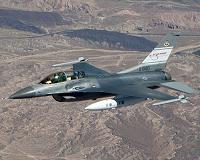
China on Wednesday blasted a huge planned US arms shipment to self-ruled Taiwan and threatened to sanction firms involved in the sale of F-16 fighter jets.
The US State Department on Tuesday approved the transfer of 66 Lockheed Martin-built F-16 fighter jets to Taiwan in a US$8 billion deal, following another huge military hardware sale agreed just last month.
The deals come as ties between Washington and Beijing are already strained by a punitive multi-billion dollar trade war.
"China will take all necessary measures to safeguard our interests including imposing sanctions on the US companies participating in this arms sale to Taiwan," foreign ministry spokesman Geng Shuang told a news briefing.
The sale "is a serious interference in our internal affairs and undermines our sovereignty and security interests", he said.
China views Taiwan as part of its territory and has vowed to one day seize it, by force if necessary.
It bristles at any countries that might lend Taiwan diplomatic support or legitimacy.
Secretary of State Mike Pompeo said in a statement Tuesday that President Donald Trump had approved the proposed sale after Congress was notified last week.
The F-16s "are deeply consistent with the arrangements, the historical relationship between the United States and China", Pompeo said.
"Our actions are consistent with past US policy. We are simply following through on the commitments we've made to all of the parties."
– 'Cancel at once' –
China said it had lodged diplomatic protests against the deal and on Wednesday urged the US to "cancel this arms sale plan at once, stop selling arms to Taiwan and cut its military contact with Taiwan".
Taiwan's plan to upgrade its air defences comes amid increasing Chinese military incursions into its air space and a spokesman for the president said the jets would "substantially enhance our air defence capabilities".
Taiwan currently has a fleet of old-model F-16s purchased in 1992, which have undergone several crucial upgrades.
Manufacturer Lockheed Martin says the newest version, known as the F-16 Block 70/72, includes many avionics, weapons and radar technologies not in existence when earlier models were created.
It is structurally stronger, the company says, so that it "can fly and fight to 2070 and beyond".
The approval of the sale comes as Washington and Beijing face off in tough trade negotiations that economists say are hurting both of the superpowers, as well as dragging down the global economy.
In a statement, the Defense Security Cooperation Agency, which oversees US foreign military sales, said Taiwan's purchase of the F-16s "will not alter the basic military balance in the region".
"This proposed sale will contribute to the recipient's capability to provide for the defence of its airspace, regional security, and interoperability with the United States."
State Department approves Taiwan's $8B deal for 66 F-16s
Washington (UPI) Aug 21, 2019 –
The State Department submitted its approval to Congress for the $8 billion sale of 66 F-16 fighter planes to Taiwan.
The Defense Security Cooperation Agency on Tuesday published it's official approval of the deal, after a week of speculation at least partially fueled by Taiwan announcing it's largest defense budget ever.
The deal would be the largest and most significant sale of weaponry to Taiwan, known globally as the sovereign Republic of China but regarded as a breakaway province by the People's Republic of China.
In addition to 66 F-16 C/D Block 70 aircraft, the deal covers spares, weapons and radar systems, construction services and all associated documents and support for the aircraft.
"This proposed sale serves the U.S. national, economic, and security interests by supporting the recipient's continuing efforts to modernize its armed forces and to maintain a credible defense capability," DSCA said in a press release, adding that Taiwan already operates the F-16 A/B and should have no difficulty absorbing the new aircraft into its armed forces.
The deal, under which Lockheed Martin would build the planes, comes as the United States and China assign tariffs to each other's imported goods and pro-democracy protests in semiautonomous Hong Kong could lead to a Chinese military crackdown which could include a confrontation with Taiwan.
Last Thursday Thursday, Taiwan passed an 8.3 percent increase it its 2020 military spending, and last month the United States approved the sales of over $2 billion in lower-level weapons sales.
By a law agreed to in 1979, Taiwan's armaments come exclusively from the United States. Thus far, the United States has denied Taiwanese requests to purchase the F-35 plane and other, more advanced weapons to counter China's military modernization, as well as China's aggressive actions in the South China Sea.
However, an air base in Taiwan for the new F-16s is under discussion by the United States, Taiwan and Lockheed Martin.
Members of Congress, on both sides of the aisle, have suggested that the F-16 deal is an element of trade talks, to be used as leverage. U.S. President Donald Trump has thus far unsuccessfully attempted to link the upheaval in Hong Kong to the trade negotiations.
China has criticized what it called a "vain plot" to by the United States to arm Taiwan.
