
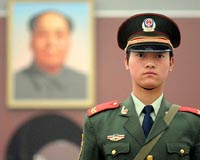
China on Thursday passed a law officially tasking the country's main domestic security force with putting down often violent incidents of social unrest, state media reported.
The People's Armed Police, whose units are stationed nationwide, had already acted in that capacity for years, but the new legislation is being seen as an overdue clarification prompted by mounting internal security challenges.
The Standing Committee of the National People's Congress, China's highest legislative body, passed the law "giving (the PAP) new duties with a statutory authorisation to respond to riots, terrorist attacks and other social security emergencies," Xinhua news agency said.
The full text of the law was not immediately available.
State media however reported earlier this week that authorities had decided a more solid legal foundation for PAP deployment was needed due to mounting unrest in recent years.
The law's passage comes less than two months after riots erupted in Urumqi, capital of the western Xinjiang region, in which members of the mainly Muslim Uighur minority clashed with Han Chinese.
The violence, the worst ethnic unrest to hit the country in decades, left at least 197 people dead and prompted a huge deployment of thousands of PAP troops to restore order in the city.
China already sees tens of thousands of incidents of large-scale public unrest each year, typically stemming from complaints by ordinary citizens about unscrupulous local officials or businesses.
It also comes amid a security crackdown ahead of the 60th anniversary of the founding of communist China on October 1 and related festivities.
The law "makes clear that the armed police would be responsible for handling public security incidents such as riots, unrest, large-scale violent crimes and terrorist attacks," the China Daily reported earlier this week.
It also takes away the power of county-level governments to call out armed police, the paper said.
Critics have long complained about local-level officials abusing that power for self-serving ends.
The law says the PAP should only be deployed in line with central government guidelines, the China Daily said, but none of the state media reports have yet spelled out those guidelines.
Share This Article With Planet Earth
