
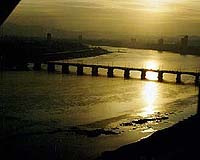
China's top environmental official said Saturday the thawing of ice in the spring will not repollute the Songhua River, the scene of a severe toxic chemical spill last year. "The final conclusion is that this spring, the Songhua River will not have a second incident of pollution," Zhou Shengxian, director of the State Environmental Protection Administration, told reporters at a news conference.
A blast ripped through a PetroChina chemical factory on November 13 in China's northeastern Jilin province, spewing tonnes of toxic benzene into the river.
An 80-kilometer-long (50-mile) slick of benzene consequently surged down the Songhua into the city of Harbin leaving up to four million people without tap water for days.
The spill also caused alarm in neighboring Russia as the Songhua feeds into the Amur which provides the main source of drinking water for the 600,000 residents of the Russian city of Khabarovsk.
China managed to reduce the risk by increasing the flow of water through reservoirs into the Songhua to dilute the chemical.
Experts however had warned that the problem could become worse in spring when ice flows that have trapped some of the pollution melt.
But Zhou said Saturday that Chinese and Russian experts have analyzed the water and concluded there was currently no danger and would not be any danger once the ice melted.
"Our final conclusion is Songhua River's fish are safe to eat, the dairy products made by farms (on the banks of the river) can be eaten," said Zhou.
Traces of pollution were found in the Amur in December but tests found they presented no danger to humans, Russian officials have said.
China has been embarrassed by the accident, one of the biggest environmental problems it has faced in recent years, which highlighted the environmental costs of its rapid industrialization and economic growth.
Source: Agence France-Presse
