
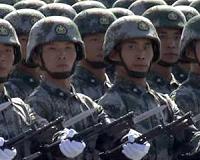
China will raise its defence spending by 7.6 percent this year, a budget report to the country's Communist-controlled parliament showed on Saturday.
It was the "lowest defence budget increase in six years", the official news agency Xinhua said, adding it came "in the wake of rising economic headwinds and last year's massive drawdown of service people".
At a giant military parade in Beijing last September to commemorate the 70th anniversary of Japan's World War II defeat, Xi announced the PLA would be reduced by 300,000 personnel, as China seeks to craft a more efficient and effective People's Liberation Army (PLA).
The PLA is the world's largest standing military but China's total declared spending of 954 billion ($146 billion) remains far below that of the US.
The increase — more conservative than the double-digit rises of past years — comes as Beijing increases its military heft and asserts its territorial claims in the South China Sea, raising tensions with its neighbours and with Washington.
It unveiled a revamped military structure at the start of the year, establishing a new army general command and a Rocket Force to oversee its strategic missiles.
In 2015, the budget was increased by 10.1 percent.
China sets 2016 growth target at '6.5-7 percent': speech
Beijing (AFP) March 5, 2016 –
China on Saturday cut its growth target for this year to a range of 6.5 to seven percent, the text of a speech to be delivered by Premier Li Keqiang showed.
Among the "main development targets" for the world's second-largest economy this year were "GDP growth 6.5 percent to 7 percent", read Li's speech to the opening of the National People's Congress parliament, the country's Communist-controlled legislature.
"A comprehensive analysis of all factors shows that China will face more and tougher problems and challenges in its development this year, so we must be fully prepared to fight a difficult battle," it said, adding that "downward pressure on the economy is growing".
China is a key driver of global growth but expansion fell last year to 6.9 percent, its lowest in a quarter of a century, and worries over its health have sent tremors through stock markets around the world.
Li struck a deeply realistic tone. The speech catalogued the impact on the country's outlook of weak trade growth, fluctuations in commodity and financial markets, and rising geopolitical risks, concluding: "We should not underestimate the impact all of this will have on China's development."
The growth target had been set at "about seven percent" last year.
China's leaders have traditionally declared the GDP goal at an easily achieved level that was regularly exceeded, and even then the objective is usually approximated to provide room for positive spin just in case.
Using a range, rather than a single figure, will widen the target even further.
– 'Market expectations' –
China was also targeting consumer inflation of "around 3 percent" and unemployment "within 4.5 percent", the text said.
It did not give a specific target for trade, which fell last year, only aiming for "a steady rise in import and export volumes" and "a basic balance in international payments".
It also pledged "further reductions in the release of major pollutants".
China is attempting a difficult transition from dependence on exports and investments to consumer-led growth.
Premier Li's speech pledged that authorities would make much-needed cuts to overcapacity in the steel, coal, and "other industries facing difficulties".
The country's leaders have sought to reassure jittery global markets in recent weeks with a unified message that authorities still have monetary and fiscal policy tools in their arsenal to keep the economy from further slowdown.
The text projected a government deficit for 2016 of 2.18 trillion yuan, reaching a deficit-to-GDP ratio of 3.0 percent, which would be the highest since the founding of the People's Republic in 1949.
This week, following a meeting of G20 finance ministers in Shanghai, the central bank trimmed the proportion of funds banks must set aside as reserves in an attempt to free up funds for lending, as a further stimulus to growth.
At the G20 meeting last month People's Bank of China governor Zhou Xiaochuan said that there was no basis for further depreciation of the yuan currency
Days later, the bank fixed the exchange rate at a four-week low.
"In setting a projected growth rate of between 6.5 percent and 7 percent we have taken into consideration the need to finish building a moderately prosperous society in all respects and the need to advance structural reform," said the speech text, distributed to journalists at the Great Hall of the People in Beijing.
"It will also help guide market expectations and keep them stable."
