
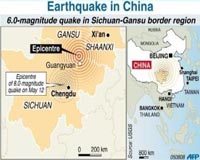
China's massive reconstruction effort after last year's earthquake helped offset the disaster's impact on the economy and has brought massive investment to a traditionally poor area, analysts say.
Homes are being rebuilt and plants put back on line in a government-funded burst of activity in the southwestern province of Sichuan that has even meant some relief from the global financial crisis, they say.
"The earthquake has provided a cushion for the Chinese economy during this period of economic turbulence," said Sherman Chan, a Sydney-based analyst at research firm Moody's Economy.com.
"The government was keen to rebuild the Sichuan area, so investment activity actually picked up, and that was a positive contribution to the GDP."
While the 8.0-magnitude quake exacted an enormous human toll — nearly 87,000 dead or missing — its impact on overall national growth was minimised by affecting a relatively destitute mountainous area.
"It's a little bit of a delicate point but it hit a fairly poor area and most of the casualties were fairly poor," said Mark Williams, a London-based economist with Capital Economics, a research consultancy.
"It does mean that in terms of the overall economy, it was far less (of an impact) than if the earthquake had hit Chongqing or somewhere like that," he said, referring to one of the largest cities in China.
According to the Sichuan provincial government's figures, the impact from the earthquake was felt on its annual GDP growth, which slowed in 2008 compared to the previous year.
Overall GDP for the province in 2008 came to 1.25 trillion yuan (180 billion dollars), a 9.5 percent rise from 2007, down from 14.2 percent the previous year.
In the second quarter of 2008, which included the month of May when the earthquake struck, economic growth was 4.6 percent compared to 14.5 percent in the first three months of the year.
"The quake had a follow-on effect to the rest of the country as well, because resources were directed to the Sichuan province as opposed to being used elsewhere," Chan said.
However, this negative trend started to reverse as reconstruction efforts began after the quake left more than five million without a home, and the province's economy rose 10.1 percent in the third quarter of 2008.
Chen Xingdong, a Beijing-based economist at BNP Paribas, said the government had set aside one trillion yuan for reconstruction work, which would have created jobs and economic growth.
"That can translate into 0.3 to 0.5 percentage points of (national) GDP growth for each year from 2009 to 2011," he said.
According to Sheng Yi, a professor at the Sichuan Academy of Social Sciences, fixed-asset investment — a measure of government spending on infrastructure — in the quake-hit zone rose 90 percent year-on-year in the first quarter of 2009.
"In some counties it's higher than 100 percent, and fixed-asset investment growth is considered high when it reaches 20 to 30 percent," he said.
This strong growth "has pushed the economy forward and boosted demand in cement, steel and consumption."
But analysts pointed out that the earthquake had led to the loss of many talented people.
"They lost a lot of engineers, managerial personnel," said Chen.
Businesses in the petrochemical, machinery, electricity and food industries were also severely affected by the quake.
"This is due to the industry cluster of equipment manufacturers in this area and because petrochemical companies have a complete industrial chain from mining to refining," said Sheng.
Share This Article With Planet Earth
