
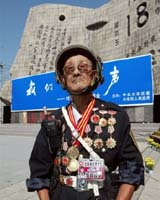
China marked the 75th anniversary Monday of what many see as the start of Japan's brutal World War II aggression, which would eventually cost an estimated 35 million dead and injured. The "Manchurian Incident," a rail sabotage engineered by Japanese forces as an excuse to annex northeast China, took place on September 18, 1931, leading to the founding of the Japanese puppet state of Manchukuo in the northeast.
"The September 18th Incident was the opening salvo of Japan's comprehensive armed invasion of China that later proceeded through Asia and the Pacific region," Xinhua news agency said.
Fourteen cities in China's northeastern province of Liaoning will sound air raid sirens Monday evening at the precise time that Japan's army blew up a local railway line.
Following the explosion, the Japanese army blamed a nearby garrison of Chinese soldiers for sabotaging its supply lines.
Within a matter of months, they had moved to occupy all of northeast China, including the three present-day provinces of Liaoning, Heilongjiang and Jilin.
To mark the event, an exhibition entitled "Remember History and Cherish Peace," opened at the September 18 History Museum in Liaoning's provincial capital of Shenyang.
A photo exhibit on Japan's invasion was unveiled at Beijing's Anti-Japanese War Memorial Hall.
The anniversary will also be marked with the showing at over 100 universities of a new Chinese-made film on the international war tribunal trial of 28 Japanese war criminals after the end of hostilities.
"Tokyo Trial" debuted on September 1 and will be shown in cinemas and universities nationwide Monday, Xinhua said.
Sino-Japanese relations are currently at a low point with Beijing blaming repeated visits by Prime Minister Junichiro Koizumi to Tokyo's Yasukuni Shrine, where several convicted Japanese war criminals are memorialized.
Koizumi, who last visited the shrine in mid-August, insists that he makes the visits to commemorate Japan's commitment to peace and pray for the millions of Japanese war dead also enshrined there.
China frequently criticizes Japan over its wartime brutality and refuses summits with Koizumi because of the visits.
Source: Agence France-Presse
