
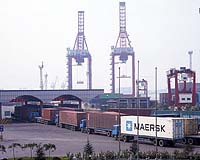
China will lower import tariffs on raw materials for certain sectors next year to help Chinese manufacturers cope with tough economic conditions, the government said on Wednesday.
It will maintain an average import tariff rate of 9.8 percent in 2009, but will fine-tune rates on raw materials that are in strong demand by the textile, steel and fertilizer industries, the finance ministry said in a statement.
"(We) will further enhance customs tariffs' role in maintaining the steady growth of foreign trade … and expanding domestic demand … to counter the impacts of the international financial crisis," the statement said.
The average tariff on agricultural products will remain 15.2 percent while that on industrial items will stay at 8.9 percent, the ministry said in the statement on its website.
The government said it would continue to cut tariffs on products from nations including Chile, Pakistan, New Zealand and Singapore according to a series of trade and tariff agreements.
China lowers taxes on property to boost real estate industry
China announced Wednesday a series of tax cuts and supports to boost the nation's flagging property market, including a plan to provide housing for almost 10 million poor families.
To support the real estate market during the global downturn, China will cut business and transaction taxes, subsidise low-income housing and make more credit available for property developers, the government announced.
"We must push forward the healthy development of the real estate sector," said a statement issued by the cabinet following a meeting chaired by Prime Minister Wen Jiabao.
"We need to expand the policy scope, quicken the pace of low-housing construction, better encourage and support housing purchases and maintain the reasonable investment scope of the property sector."
China has taken a number of measures to boost domestic demand and cope with the global economic downturn, including repeated interest rate cuts and a four trillion yuan (586-billion-dollar) stimulus package announced last month.
The government said it would also expand the money supply in 2009 and widen bank lending to a range of areas including small and medium export-oriented enterprises and infrastructure projects.
Wednesday's measures also aimed to increase investment and subsidies in low-income housing in an effort to provide homes for 7.5 million poor urban families and another 2.4 million poor rural families, it said.
China's weakening property market is likely to put further pressure on its slowing economy as investment in the sector accounts for more than 20 percent of the country's urban fixed-asset investment.
China's urban property prices rose 0.2 percent on year in November, lower than the 1.6 percent rise in October and the slowest growth in more than three years, according to official figures.
Share This Article With Planet Earth
