
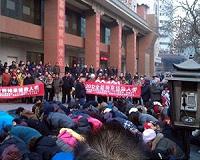
China has since June arrested nearly 1,000 members of a Christian sect which Beijing refers to as a "cult", state media said on Tuesday.
Those arrested are members of "Almighty God", a Christian group which has attracted followers in some parts of the Chinese countryside for more than a decade.
They include "high-level organisers and backbone members" of the group, the official Xinhua news agency said, citing officials.
It did not give details of what crimes the suspects, said to come from more than six provinces, are accused of.
China has previously cracked down harshly on groups it labels as "cults", most notably the Falungong spiritual movement which was banned in the late 1990s.
Falungong members insist they were targeted because the ruling Communist Party saw the group as a threat, detaining and allegedly torturing thousands of its followers.
Beijing has for years struggled to suppress the Almighty God group, with state media reporting the arrest of "nearly 1,000" followers in 2012, when the organisation was under the spotlight for predicting an apocalypse.
Almighty God told members at the time that a "female Jesus" had arrived and called on members to overthrow the Communist Party, which it refers to as "the big red dragon", the state-run Global Times reported.
State media says the group brainwashes its members and encourages them to isolate themselves from family and friends.
This year's crackdown follows the May murder of a woman at a McDonalds in the eastern province of Shandong, which police blamed on members of Almighty God.
Five people will go on trial on Thursday in connection with the murder, Xinhua said.
The movement's founder is reported to have fled to the United States.
China tightly controls the exercise of religion, permitting worship at government-controlled Buddhist, Daoist, Muslim, Protestant and Catholic establishments but banning other religious organisations.
Beijing often proclaims that it grants citizens wide-ranging religious freedoms.
Hong Kong Law Society president resigns over support for Beijing
Hong Kong (AFP) Aug 19, 2014 –
The head of Hong Kong's Law Society resigned Tuesday following a no-confidence vote after he backed a Chinese government policy document which many lawyers saw as a threat to the rule of law and judicial independence in the city.
China in June issued its first ever white paper stipulating how Hong Kong should be governed in what was widely interpreted as a warning to the city not to overstep the boundaries of its autonomy.
It included an assertion that judges should safeguard national security and sovereignty, a sentiment which has angered many in the the city's legal community who consider it an affront to their judicial independence.
The Law Society sent a strong rebuke to Beijing after it passed a vote of no confidence in Lam on Thursday, with 2,392 of its 8,000 members supporting the motion while 1,478 voted against.
"To preserve the unity of the Law Society, I will hand in my resignation letter to the council, with immediate effect," Lam told reporters Tuesday.
"I reserve my own rights to my own opinion on the entire issue," he said.
The vote by the lawyers also said Lam should withdraw his support for the white paper.
Lam in June called the white paper a "positive" document, despite growing anger in the city over perceived interference by Beijing.
Hong Kong was handed back to China by Britain on July 1, 1997 under a "one country, two systems" agreement, which allows residents civil liberties not seen on the mainland, including free speech and the right to protest
But public discontent is at its highest for years notably over Beijing's insistence that it vet candidates before the vote for the city's next leader in 2017.
More than a thousand lawyers all dressed in black took to the streets of Hong Kong in June in a silent march against interference by Beijing in the city's judiciary.
After the publication of the white paper, the Hong Kong Bar Association said in a statement that judges should safeguard judicial independence as they are not the government's "administrators".
