
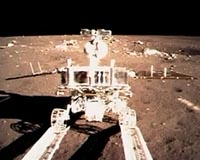
China has acquired the basic technology to carry out manned lunar missions, chief engineer of China's manned space program Zhou Jianping said Thursday. Compared with current missions, the technology used for manned lunar missions are more complex, Zhou said.
In order to achieve the goal of carrying out manned lunar missions, China needs rockets with greater load capacity, manned aircraft that can land on the lunar surface and return, and aircraft that can shuttle between Earth and the moon, Zhou said.
In addition, Zhou disclosed that the Wenchang Satellite Launch Center in southern China's Hainan Province is likely to be the second launch site for China's manned space program.
China's space station and cargo spacecraft will be launched at the Wenchang launch site, Zhou said, adding that from a technical perspective it is better to carry out manned lunar missions at the Wenchang site.
Completed in 2014, the Wenchang launch site is the fourth of its kind in China. Being the closest site to the equator, Wenchang boasts considerable latitudinal advantages. Satellites launched nearer the equator have a longer service life as they have a shorter journey to make it into geostationary orbit and save fuel accordingly.
"China has begun to develop a Mars probe, but such exploration will be a very complex project," Zhou added.
China to share space development benefits with all
Beijing (XNA) Sep 19 – China will share the benefits of the development in its manned space program with all countries, especially developing countries, a space program official said Wednesday.
China will also expand international cooperation on equipment research and development, space application, astronaut training, joint flight and aerospace medical care, said Wu Ping, deputy director of the manned space engineering office, at a press conference.
China has signed multiple cooperation agreements with countries such as Russia, Germany and France, and organizations including the European Space Agency (ESA) and the United Nations Office for Outer Space Affairs, according to Wu.
"We have always insisted on conducting international exchanges and cooperation on the basis of mutual respect, equality, mutual benefit and transparency, jointly promoting the progress and development of space technology," she said.
At the press conference, Wu said China will launch its Tiangong-2 space lab at 10:04 p.m. Thursday.
Tiangong-2's payload includes POLAR, a collaboration between ESA and Chinese institutions to study gamma ray bursts. A Sino-French research project on astronaut cardiovascular function will also be conducted via the space lab.
In July, Chinese astronaut Ye Guangfu participated in an advanced underground training course organized by the ESA in Italy.
"We are willing to work with all countries […] to make contributions to peacefully use space and create benefits for mankind," Wu said.
