
The fall of an asteroid in the Yucatan Peninsula (Mexico) 66 million years ago is believed to have caused the extinction of dinosaurs. It also created the Chicxulub impact crater, the only such crater on Earth that still has a peak ring – a type of structure commonly found, in contrast, on the surface of several objects in the Solar System.
As a result, and despite the crater being buried under several hundred meters of sediment, scientists the world over will do anything to uncover its secrets. The IODP/ICDP Expedition 364, carried out by an international team1 of researchers from the CNRS, Aix-Marseille Universite and the Universite de Bourgogne, has published its initial findings in the 18 November 2016 edition of Science: for the first time, 835 metres of collected core samples will reveal how rock formations occurred while this type of crater developed.
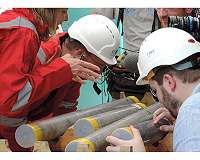
IODP/ICDP Expedition 364 began with two months of offshore drilling between April and May 2016 on board the L/B Myrtle. Shallow water drilling during this first phase of the mission allowed scientists to collect 303 core samples (sediments and impactites2) of excellent quality, and nearly 6 km of accumulated well data.
This data was analyzed by an international team of around 30 scientists, four of whom work for French laboratories: the first to unearth the rocks that form the peak ring of an impact crater.
This is the first time the peak ring of a meteorite crater has been drilled. A peak ring is a circular structure of often irregular hills located inside a large crater.
Frequently observed on the surfaces of silicated bodies in the Solar System, including the Moon, Mercury and Venus, these topographical structures are the subject of considerable debate as to how they formed, and, until now, had never been sampled.
Researchers observed that the peak ring is predominantly made up of granitic rock (combined with molten rock) which, in addition to being shocked, was shifted several kilometres towards the surface during impact. These rocks are also cross-cut by shear zones. Analysis shows that impact generated vertical fluxes and increased porosity in planetary crust.
The type of rocks that form the peak ring on the Chicxulub crater and their physical characteristics confirm the 'dynamic collapse' model of peak-ring formation.
These results are the first in a long series that will partially lift the veil on this type of crater, from the role it plays in the geology of the planets to its impact on climate. Researchers also hope to determine whether ancient or more recent types of microbial life were able to grow in the rocks of the peak ring.
