
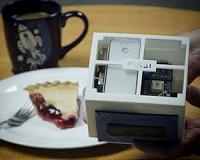
The Innovative Technology Partnerships Office (ITPO) at NASA's Goddard Space Flight Center in Greenbelt, Maryland, invites educators, students and the general public to celebrate Pi Day and discover Pi-Sat.
Current technology trends indicate a shift in satellite architectures from large, single-satellite missions to small, distributed spacecraft missions. At the center of this shift is the small satellite and CubeSat architecture.
The primary goal of the Pi-Sat project is to create a low-cost and easy-to-use distributed spacecraft mission (DSM) test bed to facilitate the research and development of next-generation DSM technologies and concepts.
This test bed also serves as a realistic software development platform for small satellite and CubeSat architectures.
The Pi-Sat is based on the popular Raspberry Pi single-board computer. Raspberry Pi runs the Linux operating system and can easily run the Goddard-developed Core Flight System (CFS) software architecture.
The Pi-Sat models currently include a Pi-Sat 1U Cube, a Pi-Sat Wireless Node, and a Pi-Sat CubeSat processor card.
The Pi-Sat project takes advantage of many popular trends, including 3-D printing, rapid prototyping in order to provide a realistic platform for flight software testing, training and technology development.
The CFS software architecture is available to the public under a NASA Open Source Agreement. To learn more and/or to obtain a copy of the CFS suite please, visit here
