
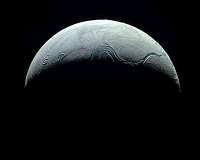
The heavens often seem vast and unchanging as seen from Earth, but movement in the skies is the norm. The relative motions of both Cassini and Enceladus over a 15-minute period create the movement seen in this movie sequence.
Cassini has monitored Enceladus (313 miles or 504 kilometers across) with a particular interest in the plumes and the geology of the south polar region for many years. Different viewing geometries give scientists different information, and the resulting animation gives us a unique "spacecraft's eye" view of the flyby.
The movie is a composite of six images taken with the Cassini spacecraft narrow-angle camera on Aug. 1, 2017 using filters that allow infrared, green, and ultraviolet light. The image filter centered on 930 nm (IR) was is red in this image, the image filter centered on the green is green, and the image filter centered on 338 nm (UV) is blue.
The view was obtained at a distance of approximately 112,000 miles (181,000 kilometers) from Enceladus. Image scale is about 0.6 mile (1 kilometer) per pixel.
Saturn Plunge Nears for Cassini Spacecraft
NASA's Cassini spacecraft is 18 days from its mission-ending dive into the atmosphere of Saturn. Its fateful plunge on Sept. 15 is a foregone conclusion – an April 22 gravitational kick from Saturn's moon Titan placed the two-and-a-half ton vehicle on its path for impending destruction. Yet several mission milestones have to occur over the coming two-plus weeks to prepare the vehicle for one las … read more
