
The Canadian Coast Guard announced Wednesday it has selected Telesat to provide ship-to-shore communications via satellite. This represents the second commercial phase for the ESA-supported project, Marine eCommerce Applications.
MeCA proved its capabilities in 2005, when Telesat, in Gloucester, Ontario, began offering Internet services to passengers aboard Canadian ferries. The new agreement with the Canadian government calls for Telesat to provide satellite equipment to selected Coast Guard vessels, which will be used to access e-mail, watch satellite television and use Voice over Internet Protocol phones.
Loyola Hearn, the Canadian Minister of Fisheries and Oceans, called the development significant for crews who spend long periods at sea, enabling them to stay in touch with their families and events at home.
The project recently completed its first phase at a Telesat testing facility. In phase two, which began last April, satellite equipment was installed in a vessel in the Coastguard's Maritimes region. Phase 3 will involve installation and training as well as introduction of the system to the four remaining Coast Guard regions: Newfoundland, Quebec, Central and Arctic, and Pacific.
Telesat will provide each ship with a satellite terminal with a full-motion antenna system and modem connected to Telesat's teleport. The same equipment is suitable for vessels of all sizes and the full system rollout is expected to be completed within two-and-a-half years.
About 2,200 Coast Guard employees will receive e-mail accounts accessible through a Web-based mail system. They also will be able to watch television and have access to satellite channels.
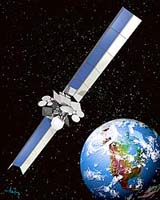
The satellite signal will be delivered via Telesat's Anik F2 satellite, which uses Ku-band and is capable of delivering Internet speeds of approximately 2 megabits per second.
The MeCA project, supported by ESA's Telecommunication Department, has functioned as a test-bed for future Internet-at-sea projects such as the one currently under way with the Coast Guard. MeCA acted as a proving ground for the antennas and terminal equipment.
