
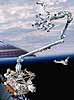
The Canadian Space Agency's new space robotic arm for the Space Station's Remote Manipulator System, was delivered Sunday to Kennedy Space Center.
The completion and delivery of the first element of Canada's contribution to the International Space Station, represents a turning point in Canada's Space Program and in this country's involvement in the Station.
The new Space Station arm builds on Canada's renowned robotics tradition and is bigger, more sophisticated and more versatile than the Space Shuttle robotic arm (CANADARM). The Space Station arm is over 17 metres long and is able to relocate itself and travel along the Station to perform tasks where required.
The Space Station Remote Manipulator System was shipped to the Space Station Processing Facility of NASA's Kennedy Space Center to undergo numerous integration, compatibility and verification tests with the elements provided by the other partners of the Station. Workers and engineers from the Canadian Space Agency and NASA are currently unpacking and re-assembling the various segments and pieces of the new arm to allow testing to start in a few days.
The SSRMS is one component of Canada's main contribution to the International Space Station, the Mobile Servicing System (MSS). Other elements of the MSS are:
the Mobile Base — serves as a storage location and work platform for the SSRMS, the Special Purpose Dexterous Manipulator and the astronauts;
the Special Purpose Dextrous Manipulator (SPDM ) — a sophisticated dual-armed robot capable of handling the more delicate tasks which normally required astronauts to perform space walks;
the Mobile Servicing System Operations Complex (MOC) — a state-of-the-art centre which includes a number of facilities playing a unique role in supporting Space Station mission planning and operations, as well as in training astronauts to use the SSRMS.
The Mobile Servicing System is an essential tool for building and maintaining the Space Station. The MSS is also helping several Canadian high-tech firms develop unique, highly sought-after expertise and create high quality jobs in advanced technology sectors.
The industrial team responsible for developing the new robotic arm is led by MacDonald Dettwiler Space and Advanced Robotics Ltd. of Brampton, Ontario (formerly the Space and Advanced Robotics Division of Spar Aerospace Ltd.). MacDonald Dettwiler's main sub-contractors are CAL Corporation (Ottawa, Ontario), SED Systems (Saskatoon, Saskatchewan), CAE Electronics Ltd (St. Laurent, Quebec), FRE Composites (St-Andre, Quebec) and IMP Group Ltd (Halifax, Nova Scotia). Several other sub-contractors across Canada were also involved in the development of the SSRMS.
Currently the new Space Station robotic arm is scheduled to launch in 2000 during mission STS-100 with CSA astronaut Chris Hadfield. During that mission, Chris Hadfield will also become the first Canadian to venture outside the Shuttle as he will perform the first ever Canadian space walk to install the new arm on the Station.
