
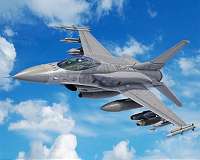
Bulgarian President Rumen Radev on Tuesday vetoed a $1.3-billion deal to buy eight F-16 fighter jets from the US, saying there had been insufficient debate before parliament approved it.
"Due to the shortened legislative procedure, a series of important issues remained unclear such as costs, guarantees, delivery times, forfeits, indemnities," Radev said Tuesday.
Given the strategic importance of the agreement, this was not acceptable, he added.
Under the $1.3-billion (1.1-billion-euro) package deal with the US, Bulgaria's government agreed to buy eight F-16 Block 70 multi-role fighter jets for its airforce.
The deal also included missiles, training and support, making it the country's biggest military equipment purchase since the fall of communism three decades ago.
The defence minister had already signed the deal and the new aircraft were scheduled for delivery between mid-2023 and early 2024 to replace the NATO member's ageing Soviet-built MiG-29 fighters.
Parliament ratified the costly purchase in a "fast-track" procedure last Friday that allowed lawmakers to scrap discussions between the required two votes on the deal.
But the high price of the purchase triggered heated, if shorter, debates initiated by the socialist opposition, who wanted more details about the deal — while not objecting to the need to buy more aircraft.
Radev cited these debates as a sign of the "lack of national consensus and conviction in the mutually beneficial terms of the agreement".
The president is a former pilot and air force commander and as president is also commander-in-chief of the army. He favoured choosing a cheaper option, such as Sweden's Gripen fighters.
He has also argued that other countries, such as Slovakia and Bahrain have paid less for the US fighter in recent deals.
On Tuesday, he argued that Bulgaria needed a multifunctional aircraft with a full package of arms, equipment and training, but added: "The public deserves a categorical answer if this is indeed achieved with the signed agreements."
Parliament will now have to hold another debate and vote again on the deal.
But lawmakers are expected to approve it and this time Radev will have to sign it into force.
4 defense giants to vie for Canadian fighter jet contract
Ottawa (AFP) July 23, 2019 –
Canada said Tuesday it would accept proposals from four global defense contractors — Airbus, Boeing, Lockheed Martin and Saab — to replace 88 aging fighter jets.
The contract is reportedly valued at a minimum Can$15 billion (US$11.4 billion).
After 18 months of consultation with the industry, "the formal request for proposals has now been released to eligible suppliers," the government said in a statement.
On arriving in power in 2015, the government of Prime Minister Justin Trudeau cancelled an order for F-35 stealth fighters from Lockheed Martin meant to replace its antiquated fleet of CF-18 Hornets.
The defense contractors have until the spring of 2020 to submit initial proposals with a contract award due in early 2022 and delivery expected in 2025.
"This is the most significant investment in the Royal Canadian Air Force in 30 years," the statement said.
Canadian media reports indicate the contract is worth between Can$15 billion and Can$19 billion.
Sweden's Saab manufactures the multirole Gripen fighter aircraft, and Airbus is part of the consortium producing the Eurofigher Typhoon with BAE Systems.
Lockheed Martin manufacturers the F-35 stealth fighter and Boeing makes the F/A-18 Super Hornet.
France's Dassault Aviation took its Rafale out of the running in November because of technical requirements tied to Canada's membership in the "Five Eyes" signals intelligence sharing group of nations that the company could not meet, sources told AFP.
The Five Eyes group includes Canada, the United States, Britain, Australia and New Zealand.
The new aircraft's central role will be to patrol North American air space with the US Air Force under the joint US-Canadian North American Aerospace Defense Command (NORAD).
After a trade dispute with Boeing, the Trudeau government in 2017 announced that, instead of buying 18 new Super Hornets, it would buy 18 used F-18s from Australia as a stop-gap measure to add to its existing fleet.
