
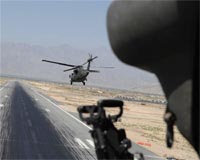
Lawmakers voiced concern Thursday that a lack of helicopters was having "adverse consequences" on Britain's campaign in Afghanistan after Prime Minister Gordon Brown denied it was causing casualties.
A report from the House of Commons defence committee said a larger fleet would allow troops to undertake operations by air rather than on foot, which would improve their effectiveness and offer them more protection.
However, Brown repeated his insistence that British forces had the resources and equipment they needed.
The grilling came as the funeral was held for Lieutenant Colonel Rupert Thorneloe, the most senior British Army officer killed in action since the 1982 Falklands War.
British troops suffered their blackest 24 hours yet in Afghanistan last week when eight soldiers died during the Operation Panther's Claw push against Taliban fighters in southern Helmand province, bringing the toll this month to 15.
The deaths pushed the war to the top of the political agenda and the main opposition Conservatives — who opinion polls suggest could win an election due within a year — have accused the government of under-equipping the army.
Many of those killed in Afghanistan have been hit by improvised explosive devices (IEDs) hidden in the ground, a tactic increasingly favoured by insurgents. Critics say more helicopters are needed to transport troops safely.
"We believe that the size of the fleet is an issue, and are convinced that the lack of helicopters is having adverse consequences for operations today," the defence committee report said.
Its chairman James Arbuthnot added: "We are concerned that operational commanders find they have to use ground transport, when helicopter lift would be preferred, both for the outcome and for the protection of our forces."
The report called for an increase in the number of helicopters and training crews, arguing that upping flying hours is no substitute for more aircraft.
Brown told lawmakers on Wednesday that while he lamented the recent loss of life during the Panther's Claw assault, "it's not to do with helicopters."
And speaking before the parliamentary hearing on Thursday, he insisted: "For what we're doing in Afghanistan we've provided the resources and equipment that are necessary."
In a sometimes testy exchange with Arbuthnot, Brown said the number of helicopters has increased by 60 percent in the past two years.
The Ministry of Defence separately pointed to plans to invest six billion pounds (10 billion dollars, seven billion euros) over the next decade to increase the number further.
Meanwhile hundreds of mourners attended Thornloe's funeral, including heir to the throne Prince Charles, a friend of the lieutenant colonel.
Thorneloe, 39, died alongside an 18-year-old trooper when an IED was detonated under their armoured vehicle on July 1.
The commanding officer of the 1st Battalion Welsh Guards was an "exceptionally inspirational man who always led from the front," said Major Dai Bevan before the ceremony.
"All of us in the Welsh Guards feel extremely proud and privileged to have been commanded by such a capable and gifted soldier."
Many of Britain's 9,000 troops in Afghanistan are taking part in the operation against Taliban fighters in southern Helmand province ahead of presidential elections next month.
The death toll for British troops in Afghanistan since operations began in 2001 now stands at 184, surpassing the 179 dead in the Iraq campaign.
Share This Article With Planet Earth
