
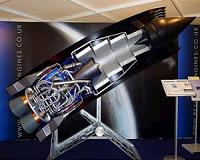
Reaction Engines, a UK-based company formed in 1989 to design and develop the technologies needed for a new class of innovative hypersonic propulsion system, claims a breakthrough in aerospace engine technology by developing ultra-lightweight heat exchangers. Such heat exchangers prevent engine components from overheating at high flight speeds.
The company's Synergetic Air-Breathing Rocket Engine (SABRE) is intended to enable aircraft to fly over five times the speed of sound in the atmosphere. One of the primary applications is to enable affordable reusable air-breathing first stages for space launch vehicles. Excessive heating at high Mach number is a fundamental problem that has prevented successful hypersonic flight in the atmosphere.
Reaction Engines was founded by three propulsion engineers from Rolls Royce, who had workedon the RB545 engine, originally intended for use on the British Horizontal Take Off and Landing (HOTOL) vehicle, a 1980s contender for a Single Stage to Orbit (SSTO) solution. Earlier this month Reaction Engines announced that its Sabre hypersonic engine passed a DARPA-funded cooling test at the Colorado Air and Space Port.
The announcement stated that the precooler heat exchanger element had run at the equivalent of five times the speed of sound at its test facility. This is a vital component that prevents the engine from overheating at high flight speeds. The Sabre could be a game changer, allowing the development of advanced vehicles such as hypersonic combat jets, Mach 5 civil aircraft and reusable space vehicles.
Reaction Engines' CTO said: "The performance of our proprietary precooler technology was validated at hypersonic flight conditions and takes us closer to realizing our objective of developing the first air-breathing engine capable of accelerating from zero to Mach 5." The next step is a trial of a full Sabre core engine within 18 months.
