
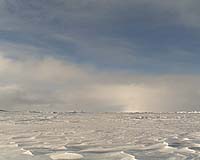
British explorer Pen Hadow said Thursday he "cannot afford to fail" on his latest daredevil mission — a three-month trek to the North Pole to measure the thickness of the melting ice cap.
Hadow said that the Catlin Arctic Survey project harked back to the golden age of British polar exploration, when men like Sir Ernest Shackleton and Robert Scott led expeditions for scientific research.
Although Hadow is the only person to have trekked solo and unsupported from Canada to the North Pole, he admitted at a London press conference that his latest 1,100-kilometre (683-mile) adventure was among his most daunting yet.
"We cannot afford to fail on this mission — there is too much at stake," he said. "As a matter of honour, we will gather as much data as we can."
As well as 100 kilogramme (220-pound) sledges, Hadow and his team, who are due to set off on or around February 24, will be dragging with them SPRITE, a radar which measures the thickness of ice every 10 centimetres throughout the trip.
The radar readings will then be fed back to Professor Wieslaw Maslowski of the Naval Postgraduate School in Monterey, California, who is leading the analysis effort.
Hadow and his team will be able to offer a provisional snapshot of how long the polar ice cap will last when they reach the North Pole at the end of May but Maslowski's authoritative findings will not be available until September.
The 46-year-old explorer admitted his "greatest fear" is balancing the struggle to stay alive in temperatures as low as minus 55 degrees Celsius (minus 67 degrees Fahrenheit) with gathering vital scientific data.
But he said the mission had distinguished historical precedents.
"We have a heritage in Britain of polar exploration," he said. "More people now (do it) as a result of people like Shackleton and Scott. In the golden age of exploration, those men were very often driven by science."
Scientists disagree about how long it will be before Arctic Ocean ice completely melts. Hadow and his team hope their findings will help provide an authoritative projection and encourage swift action.
Share This Article With Planet Earth
