
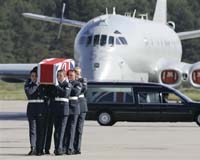
The bodies of 14 British airmen who died in a plane crash in Afghanistan were brought home Tuesday after a grim month of fighting there — but a top commander insisted the war is being won. An emotional ceremony to pay respects to them was held at the RAF Kinloss air base in Scotland, where their Nimrod reconnaissance plane, which crashed earlier this month, was based.
The crash, on September 2 near the southern Afghan city of Kandahar, caused the biggest single death toll suffered by British forces since the 1982 Falklands war. Initial signs suggest a technical fault caused the accident.
Coffins draped in the red, white and blue Union Jack flag were removed from the vast C-17 transport plane by six-strong teams of pallbearers, who slowmarched them across the tarmac to waiting hearses.
Twelve of the dead were from 120 Squadron based at the station, which is home to Britain's Nimrod fleet.
British Defence Secretary Des Browne, who also attended the ceremony, paid tribute to the dead men, many of whom came from relatively small communities around Kinloss, on the north Scottish coast near Inverness.
"They were working towards making Afghanistan a safe and secure place as well as protecting our nation and its interests. We owe them an enormous debt of gratitude for that," he said.
Some 160 relatives of the dead men attended the ceremony, shielded from public view to protect their privacy.
Britain took over command of NATO forces in the volatile south of Afghanistan in May, and have faced fiercer-than-anticipated resistance from Taliban insurgents.
A total of 33 British troops have died since then, compared to a total of 40 since NATO moved into Afghanistan in 2001 in the wake of the September 11 terror attacks in the United States.
But the British general in charge of NATO forces in the war-scarred country said in a newspaper interview Tuesday that the Taliban were being defeated.
"I believe that we are in the process of establishing psychological ascendancy," Lt. General David Richards, head of the International Security Assistance Force (ISAF), told the Daily Telegraph.
The NATO troops were also "reassuring the vast majority of the population who want us and the Afghan government to succeed, but were uncertain about which side might win, that it is going to be us," he added.
According to a recent study by the Royal Statistical Society, Afghanistan has become more dangerous than Iraq for Western troops since fighters loyal to the deposed Taliban regime renewed their insurgency.
NATO chief Jan de Hoop Scheffer meanwhile appealed to Britain's allies to send more troops to Afghanistan to support the military effort.
"We are working on getting nations to do what they promised. The question here is… that nations should live up to what they promised," the head of the 26-nation alliance told BBC radio.
Dont Abandon Afghanistan Says US As NATO Digs Around For Back-Up
Brussels (AFP) Sep 12 – On the eve of a NATO meeting to round up more troops for Afghanistan, US officials Tuesday urged its partners there to stay the course, amid fresh fighting and kidnappings in the turbulent country. US Secretary of State Condoleezza Rice issued a rallying call not to abandon Afghanistan as it struggles to build a stable democracy.
"If you allow a failed state in that strategic location, you will pay for it," she warned, speaking on a trip to Canada where she expressed her gratitude for Canada's 2,300-strong troop deployment to Afghanistan.
Her comments coincided with stark warnings of the threat posed by the fighters of the Islamist Taliban militia who are waging a bitter insurgency against foreign forces posted there after the Taliban was ousted from power in 2001.
Addressing European parliamentarians in Brussels, Pakistan's President Pervez Musharraf said the Taliban had overtaken Osama bin Laden's Al-Qaeda network as his region's biggest threat to security.
With NATO countries set on Wednesday to discuss finding extra troops to shore up their deployments in Afghanistan, a senior US official said it was too soon to know details of likely reinforcements.
Richard Boucher, the assistant US secretary of state for south and central Asian affairs, told journalists in Brussels that it was "probably a little too early" to "draw any conclusions about the efforts to get more troops".
He highlighted the dangerous situation in Afghanistan, where NATO and Afghan forces are making forays into areas held by Taliban fighters.
"As we challenged them in these areas they've challenged us back and there's been a high level of violence," Boucher said, speaking at the US embassy here.
His comments came ahead of Wednesday's meeting at NATO's military headquarters in Belgium aimed at drumming up more troops for Afghanistan.
The alliance's military chief, US General James Jones, has called for reinforcements of up to 2,500 troops to deal with increasing Taliban attacks.
The situation on the ground in the war-ravaged central Asian country turned grimmer meanwhile, as NATO pressed on with a major offensive.
Security forces killed 26 Taliban rebels and captured 28 others in separate operations across Afghanistan. Rights groups said at least 25 Afghan civilians were believed killed and 7,000 families displaced in the southern province of Kandahar since the start of the NATO operation this month.
Elsewhere, police said unknown assailants had kidnapped a Colombian aid worker and two Afghan colleagues employed by a French organisation in Wardak province, central Afghanistan.
In Britain, Lieutenant General David Richards, commander of NATO's International Security Assistance Force in Afghanistan, insisted the war against the Taliban was being won, even as the bodies of 14 British airmen who died in a plane crash in Afghanistan were brought home.
The Taliban regime was toppled by US-led forces weeks after the September 11, 2001 attacks on the United States. The US accused it of providing a safe haven for the Al-Qaeda network and its leader, Osama bin Laden, blamed for the attacks.
NATO now leads more than 8,000 troops in the restive south, and some 20,000 more soldiers from 37 countries deployed throughout Afghanistan. Nevertheless, the Taliban have dramatically stepped up their insurgency this year.
In Cuba, a summit of countries of the Non-Aligned Movement issued a draft closing statement expressing support for Kabul and their "profound" concern over "terrorist groups including former Taliban" in the south and east of Afghanistan.
NATO brass struggle to find Afghan reinforcements
Brussels (AFP) Sept 13 – Top NATO officers made no formal offer Wednesday of reinforcements to combat a raging insurgency in southern Afghanistan but gave "positive indications" that they might, a spokesman said.
"In the discussions today, positive indications were given in terms of force generation, in terms of the forces to be provided by nations to fulfill the outstanding requirement," spokesman James Appathurai told reporters.
"No formal offers were made at the table," he added.
"The discussions are continuing, they are continuing in a positive manner," he said in Brussels, some 60 kilometres (35 miles) from Mons, southern Belgium, where the senior officers from NATO's 26 member states were meeting.
Appathurai said there had also been "positive indications" on the removal of restrictions that some countries have placed on the use of their forces, and which are making NATO's mission in Afghanistan more complicated.
NATO military commander General James Jones urged the allies last week to find up to 2,500 extra personnel, to help the alliance deal with a surprisingly tenacious insurgency in southern Afghanistan led by the Taliban militia.
The reserve force would comprise a battalion of between 500 and 700 combat troops plus attack helicopters and reconnaissance staff, whose logistical backing would involve around 1,500 personnel.
As the officers met, British Prime Minister Tony Blair said the allies were duty-bound to help forces suffering casualties, mainly British and Canadian, but also Dutch, troops in the south.
"NATO and NATO countries have got a duty to respond to that," he said. "It is important that the whole of NATO regards this as their responsibility."
Since taking control of troop operations in southern Afghanistan on July 31, the NATO-led International Security Assistance Force (ISAF) has been confronted by an unexpectedly strong insurgency.
The insurgents are mainly members of the Taliban militia, ousted from government by a US-led coalition in late 2001 for harbouring Osama bin Laden, but also drug runners and fighters loyal to local warlords.
More than 90 foreign troops — including ISAF and coalition personnel — have been killed in Afghanistan this year, and the casualties in the south have raised questions about NATO's ability to successfully complete its mission.
In NATO's most ambitious mission yet, ISAF is trying to spread the influence of President Hamid Karzai's weak central government to outlying areas through provincial reconstruction teams that tie security to rebuilding.
As NATO struggles to generate forces, officials also fear that international donors could renege on financial pledges made early this year and undermine the progress in confidence-building that has been made.
In Canada, US Secretary of State Condoleezza Rice earlier warned: "If you allow a failed state in that strategic location, you will pay for it".
But US military officers acknowledge privately that Iraq, not Afghanistan, is the priority.
ISAF has some 20,000 troops from 37 countries including 8,000 confronting the Taliban and few members want to put more soldiers in harm's way.
Britain, the Netherlands and Canada are already stretched. Other major members France and Italy have made commitments to Lebanon, while Spain and Turkey have so far refused to send more.
Romania, which has already sent around 560 personnel, will probably double its contribution later this year but that offer was already taken into account before Jones made his call.
Estonia has 79 soldiers in Kandahar, Helmand and the capital Kabul and plans to increase its presence to 120 personnel at year's end, and possibly 150 next year. Latvia plans to boost numbers from 36 to 56 personnel.
The NATO spokesman said that the combat battalion would ideally involve troops from just one or two countries, but that several members could provide back-up personnel.
Source: Agence France-Presse
