
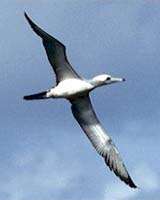
Life is looking rosier for Abbott's booby, one of the world's rarest birds and a native of Australia's Christmas Island, according to a World Conservation Union (IUCN) report Tuesday.
The species of seabird, known as Papasula abbotti, has been moved out of the "critically endangered" category in the IUCN's latest Red List into the slightly more comfortable "endangered" section thanks to conservation measures.
The world's entire population of the bird — 2,500 according to some estimates — breeds on the island, giving birth to their offspring high above the ground in nests on the rainforest canopy.
That makes the survival of the booby frighteningly vulnerable to a tropical cyclone during the breeding season, and especially to the onslaught of the non-native yellow crazy ant, Anoplolepis gracilipes.
The ant — an "introduced invasive alien species", in IUCN terminology — was accidentally brought into the Indian Ocean island starting from 1915, according to Australian Department of the Environment's website.
Since then, the hyper-multiplying ants have wiped out the local crab population, which disturbed the huge ant colonies as they moved about the forest floor, by spraying the area with formic acid.
The crabs fertilised the ground, providing vital sustenance for tree life, and ate up seedling weeds that otherwise stifle tall vegetation on Christmas Island.
Over the decades, their disappearance helped open up huge gaps in the forest canopy as trees died, and in turn eroded the breeding habitat of Abbott's booby.
The booby's ardour has been helped by 1.5 million Australian dollar ant control programme using tonnes of poisoned fish bait distributed around the island by helicopters, the Australian environment department said.
Source: Agence France-Presse
