
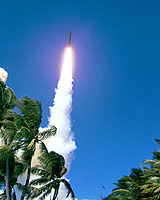
Boeing announced Thursday it has successfully tested modified underground silo and launch system components for the Ground-based Midcourse Defense interceptor, clearing the way for the silo to participate in system flight tests this summer.
The recent tests, conducted at Vandenberg Air Force Base, Calif., validated several silo modifications, the company said in a statement, including operation of the lateral support group – the three arms that stabilize the interceptor inside the silo – and the opening of the silo closure mechanism, or clamshell doors. The tests are part of a ground-test protocol to ensure mission readiness before the actual GMD system flight test.
Boeing conducted a series of six live-fire tests on a test silo in Huntsville, Ala., then verified the results on a silo at the Ronald W. Reagan Missile Defense Site at Vandenberg.
The Reagan site includes four silos currently housing two interceptor missiles that, when activated, will serve as part of the overall U.S. Ballistic Missile Defense system. The other two silos will be used for operationally realistic testing, but also can hold operational interceptors if required. Interceptors were not inside the silos undergoing tests.
The missile defense complex at Vandenberg is one of two U.S. installations housing long-range interceptor missiles. The other, at Fort Greely, Alaska, currently hosts nine interceptor missiles. The Air Force plans to place additional interceptors there during the next three years, and silos at both sites will be retrofitted with the tested modifications.
"This ground test milestone demonstrates reliability and repeatability of a 'test-as-you-fly' integrated system," said Scott Fancher, Boeing GMD vice president and program director.
Boeing is the prime contractor for the Ground-based Midcourse Defense system, the centerpiece of the Missile Defense Agency's overall layered ballistic missile defense architecture. Industry partners include Raytheon, Orbital Sciences Corp., Bechtel and Northrop Grumman.
