
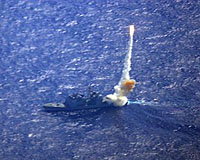
Any ballistic missile defense system deployed by the United States needs to be multilayered to have any real hope of effective operation.
Terminal defenses alone are insufficient operationally and leave the initiative in the hands of the attacker. An attacker can hope to overwhelm a terminal system or simply force the defender to play a guessing game with respect to what targets to defend. Even if an intercept of an incoming nuclear-armed intercontinental ballistic missile is successful, a terminal-only defense still permits debris to rain down on an area around the target.
Layered defenses offer a number of advantages — including more engagement opportunities, the ability to use different phenomenology and attack mechanisms against the incoming missile or its payload, the ability to undermine countermeasure strategies and the ability by the defense to apply preferential engagement strategies.
A layered system takes the initiative away from the attacker. The more layers there are, the more effective the defense and the greater the ability to both defeat an attack and defend targets.
Mobility is another characteristic that should be part of any missile defense architecture. Mobile defenses can respond to changes in the threat, reinforce fixed defenses or address the emergence of new threats. Mobile defenses can be less politically difficult for friends and allies to accept than fixed deployments.
With the addition of boost-phase systems, the armed forces of the United States will eventually be able to provide a layered defense and seize the initiative from the attacker.
A boost-phase system operates in that portion of the flight trajectory when a ballistic missile is most vulnerable and countermeasures are the most difficult to employ. Boost-phase defenses are particularly useful against long-burning intercontinental ballistic missiles such as those being developed by North Korea and Iran. At the same time, a boost-phase system is relatively less effective against shorter-burning intercontinental ballistic missiles powered by solid fuels such as those that have been deployed by Russia.
A boost-phase capability is particularly valuable in the absence of adequate midcourse discrimination or in the presence of complex threats employing countermeasures. A boost system will still need capable sensors to provide rapid and accurate target tracking.
Mobile boost-phase defenses are important because they provide strategic agility, operational flexibility, low visibility — until needed — and reassurance to allies while imposing uncertainty on the attacker.
Depending on the type of boost-phase weapon system that is available, potential deployment locations can be predetermined and supporting capabilities deployed without raising the overall visibility of the commitment to defend forward.
The characteristics that any boost-phase component of U.S. ballistic missile defense will need to have.
BMD Strategies – Part Three: Boost-Phase Design Characteristics
Depending on the type of boost-phase weapon system that is available for the ballistic missile defense systems of the United States, potential deployment locations can be predetermined and supporting capabilities can be deployed without raising the overall visibility of the commitment to provide a forward-deployed defense.
One can even imagine potential control regimes that would define the conditions under which certain boost-phase systems could be deployed by the armed forces of the United States.
A mobile boost-phase missile-defense capability would provide the White House with additional options in dealing with ballistic missile proliferation. The U.S. Navy already can provide the Obama administration with the option of deploying sea-based terminal defenses in the Persian Gulf to counter an Iranian ballistic missile threat to allies such as Kuwait and Saudi Arabia.
The addition of a mobile boost-phase capability would provide an option for the protection of more distant friends and allies and thereby, perhaps, obviate the need for the United States or others to take more extreme measures.
Looking at the kinds of threats a layered defense can be expected to face over the next decade, a boost-phase system should have certain characteristics:
It should be flexible in its deployment, it needs to have the capabilities to ensure large area coverage, and its interceptors need to have the performance capabilities that will provide them with adequate speed of engagement to intercept the ballistic missile threat.
Today, the only anti-ballistic missile defense system with any boost-phase capability is the Aegis Ballistic Missile Defense System. A sea-based boost-phase system is certainly desirable. Sea-based systems are inherently mobile and have the security associated with operations in international waters.
For there is only so much that can be done with the Aegis BMDS. Given the speed of the current Standard Missile SM-3 variant, the ship must be precisely positioned in order to have any realistic chance of engagement in the boost or ascent phase. Moreover, there are a number of potential threat trajectories that are inaccessible from a location at sea.
To pursue a boost-phase strategy, the Obama administration will have to invest in other systems. One potential candidate is the Airborne Laser that is being developed by Boeing and Northrop Grumman.
Not only could the Airborne Laser engage ballistic missiles in the boost phase, but it could also address other types of targets. Clearly, the Airborne Laser has the advantage of strategic mobility and tactical flexibility. Any major airfield can serve as a forward deployment base for the Airborne Laser.
Part 4: The advanced capabilities that will be offered for ballistic missile defense by the development of the Kinetic Energy Interceptor system
Share This Article With Planet Earth
