
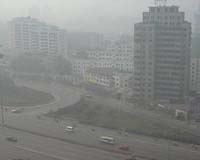
Beijing is making some progress in fighting air pollution.
So far in 2009, through the end of September, the government recorded a total of 221 days when the pollution index was below 101, on a scale of 0 to 500, The New York Times reports.
That's the most "blue sky days" since Beijing began publishing the daily measurements in 1998. During the same period, two days were rated dangerously high for air pollution, the lowest number in a decade.
"For those of us who have been monitoring air pollutants for about 10 years, we see a clear reduction in pollution," Zhu Tong, a professor and air pollution scientist at Peking University's College of Environmental Sciences and Engineering, told the Times.
The government bases its air quality index on a 24-hour average of monitors around the city. But a monitor operated by the U.S. Embassy in downtown Beijing, according to the Times, consistently reports the city's air quality as less healthy.
In 2008 Beijing's average concentration of particulates was still six times more than the World Health Organization's ideal standard. The city hasn't yet met the organization's interim air standards for developing countries, or the less stringent standards of its own national government.
On the roads, the city is taking serious steps to reduce pollution, even with an ever-increasing glut of cars. There are about 4 million vehicles in Beijing, seven times the amount about 15 years ago.
Some 4,100 of Beijing's 20,000 city buses are fueled by clean-burning compressed or liquefied natural gas, the largest such fleet worldwide.
The oldest, "dirty" cars are branded with a yellow sticker on the windshield and are prohibited from driving in Beijing's center city. To encourage the elimination of these heavy-polluting vehicles, the government initiated a "cash for clunkers"-type program in July, offering rebates of $440 to $880 to trade them in for new cars and trucks. Officials estimate this measure will help to remove some 2.7 million clunkers.
One in five of the city's private automobiles are banned from the road on weekdays, an adaption of an initiative begun prior to last year's summer Olympic Games when half of the cars were prohibited based on an even-odd license plate system. Heavy trucks are banned completely from entering the city during daylight hours.
Beijing's initiatives to curb pollution go beyond its roads.
Some of the city's 60,000 boilers and commercial heaters have been converted in the last five years to run on clean natural gas rather than coal. And the government has replaced 94,000 pot-bellied coal stoves with more efficient electric heaters since 2004, eliminating the burning of about 100,000 tons of coal each year.
Share This Article With Planet Earth
