
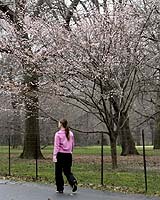
There is something wrong when New Yorkers are wearing shirtsleeves in January, and with unseasonably mild weather hitting the northeastern United States, people are wondering whatever happened to winter. Temperatures in Manhattan were expected to hit 21 degrees Celsius (70 degrees Fahrenheit) on Saturday, leaving furriers furious but bar and cafe owners rubbing their hands with glee as customers take advantage of the mild weather.
While some people were disappointed that there was no snowy white Christmas in the city this year, with temperatures in Manhattan expected to be higher than in Marrakech on Saturday, many businesses are feeling the crunch.
"Nobody's wearing fur this year. Nobody's wearing fur because it's not cold enough," said Marc Kaufman, whose family has been in the business since 1910. "If nobody wears it, it's going to affect me badly," he said.
Business at his midtown Manhattan store was noticeably down, he said.
But bars and restaurants, especially those with outdoor terraces, were seeing a marked spike in business thanks to the spring-like temperatures.
"Whenever it's warmer it's good for us, people like to sit outside and eat," said Michael Momm, who runs the Loreley Biergarten in the trendy Lower East Side. "It's obviously busier" than usual for January, he said.
Historically, temperatures in the Big Apple on January 6 range on average between minus three and plus two degrees Celsius (26 and 35 degrees Fahrenheit), according to the National Weather Service.
The warmest January day on record was seen in 1950, when the mercury hit 22 Celsius (72 Fahrenheit).
Denis Feltgen, a meteorologist with the National Weather Service, explained what was behind the unusual temperatures. "It's very simple. In two words: El Nino," he said. "We have a moderate El Nino in progress."
The cyclical phenomenon involves warmer sea temperatures in the Pacific Ocean that raise air temperatures and disrupt normal weather patterns.
The phenomenon is named El Nino — which means "the child" in Spanish and refers to Jesus — because its effects are usually noticed around Christmas.
"In a typical El Nino year, and this is certainly one of them, temperatures in the northern half of the country typically average out above normal — well above normal — and that's occurring right now," Feltgen said.
But forecasters were not expecting the phenomenon to be as strong as in the winter of 1997-1998, which was also marked by unseasonably mild temperatures.
"We expect this moderate El Nino to continue through the winter and into the first part of spring," Feltgen said. He warned that with winter barely two weeks old, cold spells could not be ruled out.
"We still have two months of winter to go and I certainly wouldn't put the snow shovels away just yet," he cautioned.
Source: Agence France-Presse
