
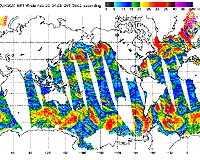
Five years after its 1999 launch, the QuikScat (Quick Scatterometer) satellite built by Ball Aerospace & Technologies Corp. continues its outstanding performance in returning essential data for global climate monitoring.
QuikSCAT employs a variation of the Ball Commercial Platform 2000 (BCP 2000) bus, the first in a line of spacecraft with proven success and reliability. The BCP 2000 can accommodate Earth-sensing instrumentation that requires precision pointing control while maintaining the flexibility needed for rapid target selection.
"We're very gratified that QuikSCAT has exceeded its design life," said David L. Taylor, Ball Aerospace president and chief executive officer.
"Our BCP 2000 has truly defined the niche for remote sensing platforms produced under commercial terms, making it the industry standard for cost, schedule and mission performance."
Originally designed for a two-year mission, QuikSCAT was delivered in only 11 months. Since that time, the BCP 2000 design has also been utilized for QuickBird I and QuickBird II.
In the near future, the Ball Aerospace-built bus will be employed on the CloudSat satellite launch in 2005 and for the National Polar-orbiting Operational Environmental Satellite System (NPOESS) Preparatory Project (NPP) in 2006. WorldView, scheduled to launch no later than 2006, will employ a larger Ball Aerospace spacecraft bus also based on the BCP 2000 design.
QuikSCAT measures near-surface wind speed and direction under all weather and cloud conditions over the Earth's oceans. In addition to the bus, Ball Aerospace provided launch interface systems, system integration and test and launch support, and continues to perform mission operations through a subcontract to the University of Colorado's Laboratory for Atmospheric and Space Physics.
Earlier this year NASA announced that data from QuikSCAT has improved 2- to 5-day forecasts and weather warnings, resulting in economic savings and a reduction in weather-related loss of life, especially at sea.
