
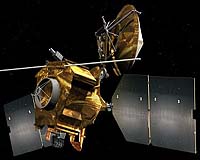
NASA's next journey to Mars, scheduled to launch August 10 from Florida's Cape Canaveral Air Force Station, will include an advanced camera built by Ball Aerospace & Technologies for the University of Arizona.
The High Resolution Imaging Science Experiment (HiRISE) is expected to provide thousands of images of the planet's surface in unprecedented detail.
One of a suite of six science instruments, the HiRISE camera is designed to image the surface at up to five times the resolution currently provided by the Mars Global Surveyor, allowing identification of objects as small as a coffee table.
Its mission is to investigate layered materials, gullies, channels and other science targets, and characterize potential landing sites for future robotic and manned missions.
The HiRISE camera is the largest and highest-resolution camera ever sent beyond Earth orbit. It will produce black and white and color images, along with hundreds of stereo-image pairs and three-dimensional digital elevation models.
The HiRISE science team expects to process 1,000 extremely large, high-resolution images and 9,000 smaller, high-resolution images during the science phase of the MRO mission.
It would take 1,200 typical computer screens to display just one large HiRISE image at full resolution. The HiRISE camera design is based on the high-resolution imaging technology proven successful by the Deep Impact and Quickbird spacecraft and several Hubble Space Telescope instruments.
"HiRISE is an important instrument in fulfilling the first steps of the new Vision for Space Exploration," said Ball Aerospace President and CEO Dave Taylor. "We expect the HiRISE camera to provide very high quality imagery for both scientific research and NASA's future mission planning," Taylor said.
The Mars Reconnaissance Orbiter (MRO) is scheduled to reach Mars in March 2006, when it will begin a six-month period of aerobraking to lower itself into the primary science orbit of averaging approximately 190 miles above the planet's surface.
The HiRISE camera and the other five science instruments are scheduled to begin operations after entering this science orbit in late 2006.
