
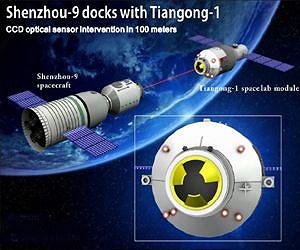
So far, so good. The first crewed expedition to China's Tiangong 1 space laboratory has been highly successful, with three astronauts travelling to the module and beginning work. In just a few days, a lot has been achieved. China has achieved another flawless flight for the Long March 2F rocket, which now sports even more improvements than its predecessors.
The production- model Shenzhou spacecraft, which made an uncrewed test flight on the Shenzhou 8 mission, has supported its first crew. We have also seen the first crewed docking of a Chinese spacecraft. The astronauts themselves seem well, too.
The next major challenge for this mission will come soon, when the astronauts board their Shenzhou 9 spacecraft for a short excursion away from the laboratory. This will be done to allow the astronauts to attempt China's first manual docking in space.
The first docking for this expedition was performed in an automatic mode, just like the mission of Shenzhou 8. Automatic docking is designated as the primary mode for Chinese dockings, and for good reason. It is more reliable and safer than manual mode. Manual docking is being tested as a possible backup technique for future missions, in case the automatic systems fail.
There has been so much practice for manual dockings that a successful outcome seems almost certain. But this is still a difficult and risky task. Even if the astronauts themselves perform at their peak, undiscovered technical issues could hamper their efforts.
Chinese planners have not spoken at length about what will happen if the docking attempt does not work, but there are plenty of backup options for the crew.
If the crew experience problems during the approach, they could simply elect to use automatic docking and return to Tiangong. Alternatively, they could back off and try again. If docking proves to be difficult, the crew has another backup option. They can return to Earth.
The timing of the manual docking attempt occurs just over halfway through the planned stay at Tiangong 1. In theory, it would be more convenient to attempt a docking test closer to the end of the mission, when most of the experimental work on the laboratory had been completed.
But there are probably technical reasons for the attempt at this time. One factor could be the availability of convenient "landing windows" in this timeframe, should a premature return to Earth be enacted.
There is also a possible tie-in with some of the biological experiments. This is more than just a test of manual docking. It is a test of the performance of the astronauts themselves. The physiology and reactions of the astronauts will probably be closely watched before, during and after the docking test.
Further monitoring will be done towards the end of the mission. Mission planners could be concerned that the skills of the astronauts could deteriorate unacceptably after too many days in space, and could thus advocate a docking test long before the end of the mission.
Let's keep our fingers crossed for a successful undocking and return to Tiangong.
