
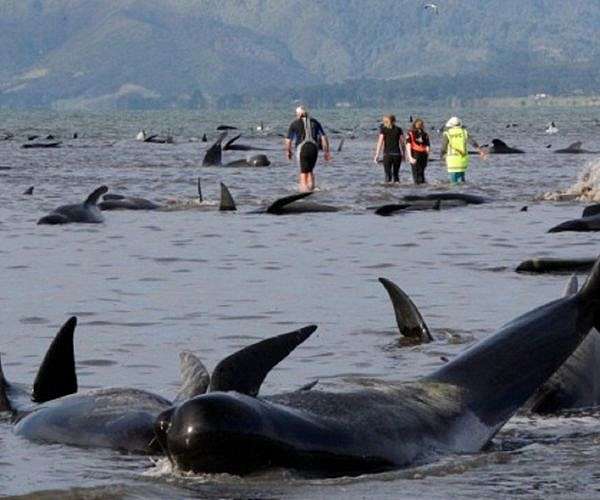
Australian rescuers were forced Thursday to begin euthanising some surviving whales from a mass stranding that has already killed 380 members of the giant pod.
While 88 pilot whales have been saved since the pod was discovered beached on Tasmania's rugged western seaboard four days ago, the death toll is expected to rise as the window for rescue closes.
"We still have a few more live animals that we think are going to be viable to move," said Tasmania's Parks and Wildlife Service manager Nic Deka, praising the hard "yakka" (work) of rescuers who will continue until nightfall and into Friday.
"There is a likelihood that we'll be continuing the rescue effort tomorrow… our focus has been on those that appear the most viable and have the most chance of success," he said.
A crew of around 60 conservationists and expert volunteers have spent days wading in the chilly waters of Macquarie Harbour, surrounded by the anguishing cries of dying whales.
"It is emotional," said rescuer Sam Thalmann.
"There are animals swimming around, they are vocalising. We can see the bonds and the pairings within them."
Pilot whales — which can grow up to six metres (20 feet) long and weigh a tonne — are highly social.
Some animals have resisted rescue or tried to return to the pod after being freed, becoming beached for a second time.
Such is the level of distress that authorities said they had to carry out mercy killings of at least four whales.
"Those four whales were euthanized earlier today," using firearms and specialist ammunition, said Tasmanian environment department marine biologist Kris Carlyon.
"We've got a few others that we currently giving veterinary assessment."
"That's based purely on animal welfare grounds," he said.
The crews are now focusing efforts on a group of 20-25 partially submerged whales, using boats fitted with special slings to guide them back to the open ocean.
But, increasingly, attention is turning to how to safely dispose of the carcases of the nearly 400 whales that have already died.
"Our preference is for disposal at sea. We're still taking expert advice about where exactly the drop-off point may be," said Deka.
Left where they are, the whales would "bloat and float", causing a navigation hazard, polluting the bay and potentially attracting sharks and other predators, Deka said.
"The decomposition of such a large number of animals could actually affect oxygen levels in parts of the harbour, which could affect the marine life in those places."
– 'Little we can do' –
A resident and cruise-boat worker who gave her name only as Monique said the local community has been devastated by witnessing scenes of such anguish.
"You could see that they were obviously suffering," she told AFP.
"On the beach they were still… puffing, flipping about and you couldn't really do much to help them."
The causes of mass strandings remain unknown despite scientists studying the phenomenon for decades.
Some researchers have suggested the pilot whales may have gone off track after being attracted by food close to the shoreline, or by following one or two members of the pod that strayed.
Marine biologist Carlyon said it was a "natural event" with strandings of the species regularly occurring in both southern Australia and neighbouring New Zealand.
"We do step in and respond in these situations, but as far as being able to prevent these occurring in the future, there's really little that we can do," he said.
Whale strandings: some notable events
Sydney (AFP) Sept 23, 2020 –
At least 380 pilot whales have died in a mass stranding in southern Australia, officials said Wednesday, in what is likely to be the biggest beaching of the cetaceans in the country's history.
Here are other notable mass strandings of whales from around the world.
– New Zealand –
New Zealand — considered as one of "hotspots" for whale strandings — has recorded incidents dating back to the 1800s.
The country's largest reported mass stranding took place in 1918, when 1,000 whales beached at the remote Chatham Islands.
More recently, hundreds of pilot whales died after nearly 700 were found on the beaches of Farewell Spit — at the top of the country's South Island — in February 2017. Another 145 died in a mass stranding the following year on Stewart Island.
– Argentina –
One of the largest known mass beachings in the last century was of false killer whales in October 1946, when an estimated 835 were stranded near Mar del Plata in Argentina.
– Chile –
In December 2015 more than 300 whales were discovered washed up on a remote Patagonian inlet in southern Chile. Scientists at the time called the sight of the stranding "apocalyptic".
A surge in algae in the water, known as a "red tide", was believed to be the culprit. It bloomed across the ocean around Chile in the early months of 2016, choking to death an estimated 40,000 tons of salmon in the Los Lagos region — or about 12 percent of the country's annual production of the fish.
In July 2016 about 70 dead whales were also found on the southern Chile coast.
– Madagascar –
In May 2008, around a hundred whales swam onto the beaches of Madagascar and three-quarters of them perished, in the first mass beaching blamed on high-frequency sonar mapping systems deployed in the hunt for oil.
According to a report released by the International Whaling Commission in 2013, the culprit was a high-power 12-kilohertz multibeam echosounder system operated by an ExxonMobil vessel about 65 kilometres (40 miles) offshore. The company disagreed with the findings.
The use of anti-submarine sonars was also suspected of causing the mass-beaching in 2002, when some 15 beaked whales perished in the Canaries after a NATO exercise.
– Japan –
In April 2015, around 150 melon-headed whales were discovered washed up on a stretch of beach in Japan.
The cetaceans, which usually live in deep water and are a member of the dolphin family, were thought to have either suffered from a parasitic infection that disrupted their ability to navigate, or had become unable to navigate in the sandy shoals.
