
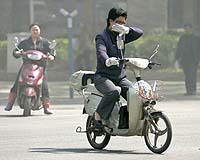
Global concentrations of carbon dioxide, the major greenhouse gas blamed for climate change, reached in 2005 the highest levels ever recorded, the UN's weather agency said Friday. The trend of growing emissions from industry, transport and power generation from burning fossil fuels such as oil, gas and coal is set to continue despite an international agreement to cap emissions, the World Meteorological Organisation (WMO) warned.
"To really make CO2 level off we will need more drastic measures than are in the (1997) Kyoto Protocol today," senior WMO scientist Geir Braathen told reporters.
"Every human being on this globe should think about how much CO2 he or she emits and try to do something about that," he said.
The latest data gathered from monitoring stations, ships and aircraft around the world were contained in the WMO's second annual Greenhouse Gas Bulletin.
Globally averaged mean ratios of carbon dioxide (CO2) in the atmosphere reached 379.1 parts per million (ppm), an increase of 0.5 percent over 2004
Concentrations of nitrous oxide (N2O), another key greenhouse gas, reached 319.2 ppm in 2005, an annual increase of 0.2 percent, the bulletin added.
"In 2005, globally averaged concentrations of carbon dioxide in the atmosphere reached their highest levels ever recorded," the WMO said in a statement.
Braathen said the levels of the two greenhouse gases were increasing at steady rates, in line with a decades-long trend.
"It looks like it would continue like this for the foreseeable future," he added.
"The current Kyoto Protocol will not be sufficient to stabilise. It will maybe reduce the increase, but this will still take time," he added.
The treaty sets limits for emissions of six greenhouse gases emitted mainly by burning oil, gas and coal, including carbon dioxide, from 2008, for the 165 countries that have ratified it.
The United States and Australia have rejected the compulsory cap, while developing countries, including China and its booming economy, are not covered by Kyoto.
A report for the British government released this week warned that unchecked climate change would cause huge economic damage worldwide, estimated at between five and 20 percent of global gross domestic product every year.
The governments involved in the Kyoto Protocol are due to meet in Nairobi from Monday to examine their future path in combatting global warming.
The environmental group WWF this week urged them to produce a "clear" plan for a "Kyoto plus" treaty on even deeper cuts in carbon dioxide emissions after 2012.
Braathen said Friday: "Every intiative to bring down greenhouse gases is a welcome one and will help maybe to convince others that change is necessary."
He insisted that the data on greenhouse gases, which scientists only began to gather and analyse systematically at a global level two years ago, was the product of consensus among scientists.
"We believe that this data has a really good scientific foundation," he said.
The bulletin showed that levels of another greenhouse gas, methane, which have been following a similar growth pattern to carbon dioxide, have begun to level off since 1999.
"This has come as a surprise to the scientific community… There is no real good explanation why," Braathen said.
Methane is produced both by burning fossil fuels, and by natural sources such as wetlands, termites, and ruminant animals like cows.
earlier related report
Scientific news grim for UN talks on global warming
Paris (AFP) Nov 5 – An upcoming UN conference on climate change is taking place against a darkening background of scientific news, for barely a week goes by without a major study adding to a tall pile of distressing evidence. Doubts about the reality of global warming that were significant half a dozen years ago have today shrunk to zero, leaving only denialists and fossil-industry lobbyists in opposition.
A steady drumbeat of data confirms the rise in Earth's surface temperature and the part played by oil, gas and coal, whose invisible carbon pollution traps the Sun's heat, in effect creating a global greenhouse.
Scientists report melting sea ice around the North Pole, shrivelling glaciers in Greenland and Europe, retreating permafrost in Siberia and progressive acidification of the seas from atmospheric carbon dioxide (CO2).
These phenomena could be the canaries in the coal mine: the forerunners of damaging, some say even potentially catastrophic, changes to the world's climate system.
Such is the backdrop to the November 6-17 meeting of the UN Framework Convention on Climate Change (UNFCCC), the parent of the Kyoto Protocol on curbing dangerous greenhouse gases.
"What was forecast back in 1990 is being confirmed today," said Jean Jouzel, a French expert who is a member of the Intergovernmental Panel on Climate Change (IPCC), the world's foremost scientific authority on global warming.
"Surface temperatures are rising by around 0.2 C (0.35 F) a decade. On top of that the effects of climate change are now visible. The skeptics are seeing their arguments melt like ice in the sun."
The IPCC was set up in 1988 by the World Meteorological Organisation (WMO) and the UN Environment Programme (UNEP) to provide neutral, science-based assessments on climate change.
Its last assessment was published in early 2001 and confirmed that global warming was underway. The next report is due in early 2007.
"We get together to update our knowledge every six years, assessing certainties and uncertainties. I don't know of any other issue where an effort of this magnitude is made," says French researcher Valerie Masson-Delmotte, who is contributing to a chapter on the climate in the past.
The 2001 IPCC report suggested that by 2100, the mean global temperature will have risen by between 1.4 and 5.8 C (2.5 and 10.4 F).
Since then, climate science has leapt ahead, both in terms of the depth and range of research and the tools, especially computer power, available to do it.
The latest lab simulations do not point to any significant shift in temperature rise from the 2001 forecast, said Jouzel.
But temperature is only one factor in an equation whose complexity, it is now emerging, is far greater than was previously thought.
The newest research says that a bland global figure of temperature rise will mask wide regional variations — which in turn will affect winds and rainfall patterns and thus fuel the risk of regional droughts and floods.
Just as worrying is evidence that triggers have been unleashed which could amplify global warming: in effect, creating a vicious circle.
These so-called positive feedbacks include the release of methane that had been locked for millennia in the frozen soil of northern Siberia, and the loss of glaciers and snow cover. Ice and snow are white and thus reflect the Sun — strip away that cover and the exposed soil, because it is dark, traps the heat.
Just as depressing is the realisation that the global warming machine will work for years and years to come.
If levels of greenhouse gases miraculously stabilised tomorrow, there is already so much carbon in the atmosphere that the temperature will continue to rise until 2300, said Serge Planton, an IPCC member who also heads climate research at the French weather agency Meteo-France.
Even though knowledge about global warming has advanced enormously, there remain significant areas of doubt, debate or ignorance.
These areas include the health of Antarctica; whether global warming will make hurricanes and other storms more vicious or frequent; and the role of the deep oceans in the highly complex interchange of heat.
The UNFCCC meeting in Nairobi will gather politicians for talks to gear up the Kyoto Protocol, a treaty with a flawed and troubled history, to meet the challenge.
Thousands of grassroots campaigners will take part, as will representatives from businesses in the fast-growing sectors of renewable energy, carbon trading and adaptation to climate change.
earlier related report
Kyoto Protocol carbon market remains promising despite turbulence
Paris (AFP) Nov 5 – Once dismissed as an oddity and hit by two crashes in less than six months, the market for carbon dioxide (CO2) emissions is nonetheless recovering battered credibility and remains alluring, experts say.
The market is the keystone of the Kyoto Protocol for curbing greenhouse-gas emissions, which comes under the microscope at a UN conference running in Nairobi from November 6-17.
The innovative — critics prefer "untested" — idea is to provide a financial incentive for tackling CO2, which traps solar heat and drives dangerous climate change.
It works like this: big polluting corporations are set a target for their maximum permitted pollution, with the threat of a penalty for every tonne of CO2 above the limit.
Those firms that become more fuel-efficient and reduce the pollution can sell their surplus permits to those that are over quota to help them meet their target. It thus dangles a carrot to everyone to get with the carbon cleanup.
So far only one mandatory CO2 market exists — the European Union's Emissions Trading System (ETS).
It comprises 11,500 big industrial firms that account for about half of the 25-nation bloc's CO2 output. They face a penalty of 40 euros (50 dollars) for every excess tonne of CO2 for 2006 and 2007, a punishment that will rise to 100 euros (125 dollars) a tonne from 2008.
Launched at the start of 2005, the ETS has had a white-knuckle ride.
At its peak, in April 2006, CO2 was changing hands at 31 euros a tonne, tripling the profit of anyone canny enough to have bought at the market's inception.
Then came chaos. EU governments announced that their economies were in fact polluting less than they thought. The goals set for the ETS participants during the startup phase had been based on estimates.
As a result, the market became flooded with sellers, and the price of CO2 crashed by two-thirds in just 10 days.
The market picked up again and remained stable for the next five months, only to slump by another 25 percent in September, mirroring a big fall in the price of gas and electricity. CO2 is currently trading at around 12 euros a tonne.
But analysts and traders remain confident, saying a revolutionary concept like the carbon market is bound to have teething troubles.
Even so, they are closely watching the EU to see how it fixes the main causes of the first crash — poor information and over-estimates — and whether it can coerce member states to tighten up quotas to meet their Kyoto targets.
Verbally, at least, the European Commission is hiking the pressure ahead of decisions, due next year, for the so-called Phase 2 of the ETS — the commitment period running from 2008 to 2012.
"Reliable reporting by member states is a crucial part of our efforts to win the battle against climate change," Environment Commissioner Stavros Dimas said on October 12 as he launched proceedings against eight EU states for failing to say how many permits they would allot polluters from 2008.
The Commission estimates that member states must slash pollution allowances by six percent to meet their obligations under Kyoto.
As for the second crash, some analysts say it was an encouraging sign of maturity — that the market for CO2 is at last linked with the markets for fossil fuels that cause the greenhouse-gas problem.
"There was astonishing stability in the carbon market in the five months between the two crashes, but it was rather an anomaly in comparison to other energy markets, and this has been corrected," says Powernext Carbon, a Paris spot trader in CO2.
Another good sign is rising market liquidity.
According to Point Carbon, a Norwegian-based consultancy, the pre-ETS carbon market in 2004 amounted to 94 million tonnes in 2004, worth 377 million euros, and rose to 799 million tonnes, worth 9.4 billion euros in 2005.
Powernext, which set up stall in June 2005, expects its own trading volume to reach 24 million tonnes in 2006, compared with four million tonnes for the last six months for 2006.
In the long term, say analysts, a carbon market will be an essential part of the panoply of weapons for tackling greenhouse gas.
The costs, but also potential rewards, of this campaign are huge.
To stabilise carbon emissions by 2050 will take total expenditure of some 60,000 billion dollars, equivalent to the world's annual global domestic product today, at a price of 20 dollar per tonne of emissions prevented, according to Shell Springboard, an initiative launched by the energy giant Royal Dutch/Shell.
Paul Watkinson, a senior official on climate change at the French ministry of ecology, says the European market is making headway and could one day be "the embryo" of a global market.
Despite US President George Bush's fierce opposition to Kyoto's mandatory approach, there is growing interest in cap-and-trade at state level.
Some experts believe a federal market will inevitably emerge after Bush leaves office in 2008, although how it could hook up with the EU's scheme is unclear.
One regional gas trading scheme is under development — the Northeast and Mid-Atlantic Regional Greenhouse Gas Initiative (RGGI), governing emissions from the energy sector. California also has a state-wide programme to cap emissions, which has provisions for a potential market.
Source: Agence France-Presse
