
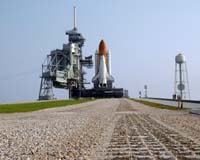
After two weather-related delays, NASA technicians moved space shuttle Atlantis 4.2 miles early Wednesday morning from the Vehicle Assembly Building to launch pad 39B at Kennedy Space Center. Riding atop the mobile launch platform and carried by the huge crawler transporter was the orbiter attached to its external tank, flanked by two solid rocket boosters.
At the pad, Atlantis will be enclosed by the rotating service structure during its preparation for launch. From there the payload for the mission will be loaded into the cargo bay.
The launch window for this mission, dubbed STS-115, to rendezvous with the International Space Station and resume its assembly, opens Aug. 27 and runs through Sept. 7. Each day's launch window runs only about 10 minutes.
The Atlantis crew is due to spend 11 days in space installing the integrated P3/P4 truss segment on the International Space Station, which along with its two large solar arrays will provide one-fourth of the total power generation capability of the facility when it is completed.
Meanwhile, the astronauts and ground crews for STS-115 will participate in a full launch dress rehearsal next week. The rehearsal is designed to provide the crew with an opportunity to participate in various simulated countdown activities, including equipment familiarization and emergency egress training.
If Atlantis does not fly by Sept. 7, its launch would have to be postponed indefinitely, because it would conflict with a Soyuz mission to the ISS scheduled for mid-September.
The STS-115 crew consists of commander Brent W. Jett Jr., pilot Christopher J. Ferguson, mission specialists Heidemarie M. Stefanyshyn-Piper, Joseph R. Tanner, Daniel C. Burbank and Steven G. MacLean, who represents the Canadian Space Agency.
