
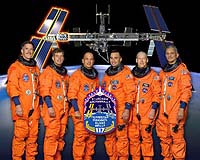
Astronauts set to take off from Florida on the shuttle Atlantis are determined to remember the mission, because it could be the last of their careers. Lee Archambault, a 20-year Air Force test pilot and longtime astronaut, has yet to fly into space, The Miami Herald reported. If all goes smoothly this week Archambault will experience his first journey into space.
Archambault, who began training in 1998, told the Herald it is not uncommon for astronauts to train for many years before embarking on a space mission. Some only get to go into space once in their whole lives.
Lisa Nowak, the astronaut who was disgraced in February after a publicized love triangle with another astronaut, reportedly trained for 10 years before stepping aboard the Discovery last summer.
"I'll probably take a little extra time to look back, from that particular vantage point, at the Earth and enjoy that," said Patrick Forrester, 50, one of the three astronauts to accompany Archambault on the Atlantis.
earlier related report
International Space Station Status Report: SS07-30
Houston TX (SPX) Jun 3 – The Expedition 15 crew completed the first of three planned spacewalks this week and prepared for the upcoming arrival of space shuttle Atlantis to the International Space Station.
On Wednesday, Commander Fyodor Yurchikhin and Flight Engineer Oleg Kotov stepped outside the station and installed five additional debris protection panels on the conical section of the Zvezda Service Module, the area between its large and small diameters. The aluminum debris protection panels are designed to shield the module from micro-meteoroids.
Also during the spacewalk, the cosmonauts relocated a Global Positioning System (GPS) antenna cable. The cosmonauts moved the GPS cable to assist the rendezvous and docking of the European Automated Transfer Vehicle later this year.
On June 6, Yurchikhin and Kotov are set to wear Russian spacesuits again and install 12 additional protection panels on Zvezda. They also will install a section of an Ethernet cable on the Zarya module and a Russian experiment called Biorisk on the Pirs Docking Compartment.
During the second spacewalk, Flight Engineer Suni Williams will remain aboard the station as the spacewalk choreographer, as she did this week, advising and keeping the spacewalkers on schedule.
Additionally this week, Williams packed science payload and personal items she will bring with her when she returns to Earth at the end of the upcoming STS-117 shuttle mission, scheduled for launch Friday, June 8 at 7:38 p.m. EDT.
Williams collected her fifth and final set of blood and urine samples for the Nutritional Status Assessment, which measures physiological changes in the human body during spaceflight. The samples are stored at minus 80 degrees Celsius in the Minus-Eighty Laboratory Freezer. The experiment will help researchers understand bone metabolism, oxidative damage, vitamin and mineral status and hormonal changes and how they relate to stress, bone and muscle metabolism. The results should provide a better understanding of what happens physiologically, and when it happens, to crew members on long-duration space missions.
