
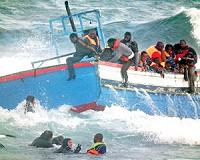
At least eight migrants drowned after their boat sank following a collision with a Tunisian navy vessel in the Mediterranean, the defence ministry said on Monday.
Spokesman Belhassen Oueslati told AFP that eight bodies were found and 38 people rescued after the unidentified boat "collided with a military vessel" Sunday evening when it was approached some 54 kilometres (33 miles) off the islands of Kerkennah.
Search operations for any more missing were "still ongoing", he said.
Several Italian media outlets reported that there were some 70 migrants on board the boat which sank, and that it had set off from Tunisia's coastal city of Sfax.
The collision happened in an area patrolled by search and rescue crews from Malta.
The Maltese coastguard told AFP that it had been informed of a collision between two vessels and had sent help, but did not elaborate.
Since summer there has been a rise in the number of migrants trying to make the perilous sea crossing from Tunisia to Europe, with small vessels heading for the Italian islands of Sicily and Lampedusa.
Flavio di Giacomo, an Italian spokesman for the International Organization for Migration, told AFP that 1,400 Tunisians had arrived in Lampedusa and western Sicily in September alone.
This compares with 1,200 registered in Italy for all of 2016.
"Tunisians who leave do not want to be intercepted because those who are detained are sentenced to two months in prison in Tunisia," he said.
A bilateral agreement between Rome and Tunis provides for Tunisians landing in Italy to be repatriated, but at the rate of a few dozen per week.
With the current number of arrivals, however, many are simply handed an injunction to leave — then they disappear.
The Tunisian Forum for Economic and Social Rights NGO said in a report last year that half of Tunisian youths from low-income neighbourhoods were thinking of leaving the country, and one in three was prepared to do so clandestinely.
It blamed the situation on increasing poverty and unemployment in the North African country.
Puerto Rico's hurricane-wracked environment faces long recovery
Bees fly around, disoriented, searching for flowers to pollinate. The trees have no leaves and once-lush mountains are a mass of dry branches.
Hurricane Maria not only destroyed Puerto Rico's infrastructure, it also wreaked havoc on the environment, disrupting the island's entire ecosystem.
And experts say the road to recovery could be long.
"There is a lot of death, but eventually t … read more
