
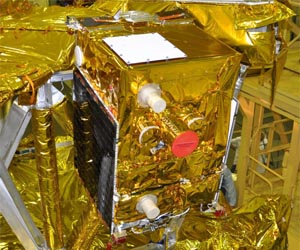
Astrofein has announced the planned launch of TET-1 satellite, a satellite for the On-Orbit-Verification (OOV) program of the German space Agency DLR. Originally the launch was planned for 2011, but was delayed due to the problems on the launch's main payload, the Russian-British Canopus satellite.
The launch is planned for July 22 using the Soyuz-Fregat launcher from the Baikonur Cosmodrome in Kazakhstan.
As of yesterday the satellite was integrated on the rocket, as shown on the right.
The TET-1 satellite platform was built by Astrofein under contract of Kayser-Threde GmbH, who are the prime contractor for the mission. In addition to that, German Space Operations Center (GSOC) at German Aerospace Center (DLR) will be responsible for the mission operation.
The Mission goal, as also for other OOV programs, is the verification (and reaching of TRL 9) of the hosted payloads during the operation time of one year in SSO. The satellite carries 11 different payloads from the German industry and science community, ranging from new batteries, new Ka-band technologies and a bi-infrared camera system.
The TET-1 is based on the TET platform design, a 70 kg satellite bus which is able to carry a payload of 50 kg. With its modular designs it will be the bus for various German and ESA missions planned for the next years.
Main advantage of the satellite is the high payload to bus mass ratio, the high reliability design (0.95 for the platform over 14 month) and a high flexibility for mission design.
It's this flexibility that allows using the satellite bus platform for high-resolution earth observation, as well as for On-Orbit-Verification or Scientific missions.
Based on the TET design, Astrofein has also developed the TET-XL platform, which is a 120 kg platform which can carry a payload of 80 kg and also includes propulsion system for on-orbit maintenance as well as constellation or formation flying.
The TET-1 will be operated as part of the OOV program for 14 months under contract of the German space agency and will be handed over then to DLR Research and Development department to be used as one part of the FIREBIRD constellation, together with the BIROS satellite which is just under integration.
The OOV program of the DLR continues with the TET-2. The study for this next OOV mission was started in June 2012.
