
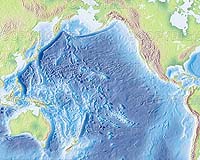
Researchers said a large amount of nitrogen oxides apparently will move across the Pacific Ocean to North America this spring to produce significantly higher levels of ozone than would have resulted from indigenous NOx emissions. "It's well-known that pollutants don't always stay in the region in which they are produced. What's not understood as well is where and when they travel," said Yuhang Wang, an atmospheric scientist at the Georgia Institute of Technology.
"Finding this large amount of NOx traveling from across the Pacific is important, because it will allow us to build better models so we can better understand how pollutants created in one region of the world are affecting the other regions."
Reporting in volume 33 of Geophysical Research Letters, Wang, along with colleagues from Georgia Tech, the University of California, Irvine, and the National Center for Atmospheric Research in Boulder, Colo., described how they were studying data from the Tropospheric Ozone Production about the Spring Equinox, or TOPSE, experiment when they found much larger amounts of an array of chemicals, including NOx, than predicted by current models.
Formed when fuel burns at a high temperature – automobile exhaust, electric utilities and industrial activity create the bulk of human-produced NOx – the amount of NOx available largely determines how much ozone – a major component of smog – is produced in most regions of the atmosphere.
"With a very small amount of NOx sitting around, as long as you have all these emissions of carbon monoxide and hydrocarbons, the NOx sits there and continuously produces ozone. So in a way you really don't need a lot of it, but when you have a lot of it, it tends to produce ozone faster," said Wang.
Current models show the NOx and related chemicals moving across the Pacific at lower altitudes, but the migration usually peaks in March and April. The discovery that higher-altitude transport occurs in May is significant, the team said, not only because it means a large amount of NOx has gone unaccounted for by current models, but also because it will occur in May, when atmospheric NOx becomes more efficient at making ozone.
"For the same amount of NOx, ozone production is faster in May than April because there is more ultraviolet light and water vapor available in May," Wang explained.
It remains uncertain whether this trans-Pacific transport is coming from Asia or as far away as Europe, but given Asia's proximity and its burgeoning industrial activity, Wang suggests it is the more likely source. He said the researchers next will take chemical measurements over East Asia to see how well that data correspond with NOx migration and North American ozone levels.
