
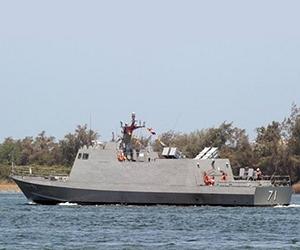
Defense Secretary Robert Gates on Saturday chided China for suspending military ties over US arms sales to Taiwan, saying Beijing's stance "makes little sense".
Renewing his call for stronger relations between the Chinese and US militaries, Gates said such a dialogue should not be "held hostage" over the long-running weapons sales.
The arms sales had been going on for decades but Washington had made clear that it did not support independence for Taiwan, Gates said in a speech at a security conference in Singapore.
"Chinese officials have broken off interactions between our militaries, citing US arms sales to Taiwan as the rationale," he said.
"For a variety of reasons, this makes little sense."
Gates had planned to travel to Beijing as part of an Asian tour that began Thursday in Singapore. But China rebuffed the defence secretary, calling off the visit as a top general cited US arms sales to Taiwan as an obstacle to promoting military relations.
As a result, Gates chose not to meet a Chinese military delegation at the Singapore Shangri-La conference.
After his speech, an uncomfortable exchange between a Chinese general and Gates illustrated the often tense relations between the two countries' militaries.
Major General Zhu Chenghu, speaking in English, asked Gates to explain what he called a contradiction between the US condemnation of North Korea over the sinking of Seoul's Cheonan warship and a more cautious US reaction to a deadly raid by Israel against a Gaza-bound aid ship.
"I think it (the Israeli raid) needs to be investigated and we will withhold judgement until that investigation is complete. But I think there is no comparison whatever between what happened in the eastern Mediterranean and what happened to the Cheonan," said Gates.
The South Korean ship was the target of a surprise attack, Gates said, while the Israelis issued warnings to the aid ship before their raid.
After his remarks, Gates walked over and shook hands with the head of the Chinese delegation, General Ma Xiaotian, deputy chief of the army's general staff.
In his speech, Gates said President Barack Obama's decision to approve an arms package for Taiwan in January should have come as no surprise, as it was in keeping with long-standing US policy.
He said Washington had declared publicly for years that it did not endorse independence for Taiwan, and added: "Nothing — I repeat, nothing — has changed in that stance."
He said China's on-off approach would not persuade Washington to alter its policy and argued that US weapons sales to Taiwan helped maintain peace and stability given China's growing military buildup.
Gates on Thursday suggested a rift between Chinese civilian and military leaders on the issue, saying it was his "opinion that the PLA (People's Liberation Army) is significantly less interested in developing this relationship than the political leadership of the country".
China says US arms sales to Taiwan run counter to the US recognition in 1979 of Beijing as China's sole government.
While calling for cooperation, Gates also said the United States would retain its elaborate military presence across the region and cultivate partnerships throughout Asia.
"We are, and will remain, a Pacific power," he said.
US officials often voice concern about China's military spending and what they consider a lack of transparency over its modernisation efforts, citing anti-ship missiles that could undermine the reach of American naval power.
Share This Article With Planet Earth
