
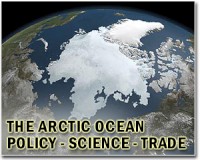
The five nations bordering the Arctic Ocean on Tuesday reaffirmed their commitment made in Greenland a decade ago to "peacefully" settle their differences over the resource-rich region threatened by climate change.
Ministers and senior officials from the United States, Canada, Russia, Denmark and Norway gathered for a two-day meeting in western Greenland's coastal town of Ilulissat, where the initial declaration was signed on May 28, 2008.
The countries hope dialogue will resolve conflicts over the sovereignty of territories, strategic maritime passages, environmental protection and fishing.
Ten years after the signing of the Ilulissat Declaration, it is still in the coastal nations' interest "to maintain the Arctic as a low-tension region, where disputes are resolved peacefully," Danish foreign minister Anders Samuelsen said in a statement ahead of the meeting.
"In other parts of the world, the Arctic states are involved in critical conflicts on different sides," Samuelsen said, adding that cooperation had been maintained in the region.
"In the time of globalisation and global uncertainty, it is important to reaffirm the core values of this exceptional region; peace and prosperity for our peoples," his Greenlandic counterpart Vivian Motzfeldt said.
The five nations are known as the "Arctic Five", while Sweden, Finland and Iceland, which are also attending to the summit, make up the "Arctic Council".
Greenland's ice sheets, the largest in the northern hemisphere, are melting due to global warming.
This has lead to a race for potential Arctic riches as it opens up new shipping routes and enables exploration of untapped resources, creating major concerns for environmentalists and the local population.
Last December, the Arctic Five and major fishing nations including China, Japan, South Korea and EU member states agreed to a moratorium on commercial fishing in Arctic waters before a fishery in the icy region was even feasible.
The decision was welcomed by Greenpeace.
Trump administration moves to lift ban on bear baiting in Alaska
Washington (AFP) May 22, 2018 –
The Trump administration on Tuesday presented a plan to roll back Obama-era rules preventing hunters in some protected zones in Alaska from luring bears with bait including bacon and donuts, and using spotlights at den sites to hunt black bear cubs and sows.
Under former president Barack Obama the National Park Service (NPS) in 2015 had prohibited a number of practices — considered cruel and harmful by animal protection groups — on national preserves in Alaska.
In addition to baiting and use of spotlights, banned methods include hunting wolves and coyotes during their denning season, the use of dogs to hunt bears, and the killing of swimming caribou from motor boats.
The NPS in a statement said reversing the ban on those practices would "establish better consistency" within the state of Alaska, where such methods are allowed in areas not under federal protection.
"This proposed rule will reconsider NPS efforts in Alaska for improved alignment of hunting regulations on national preserves with State of Alaska regulations, and to enhance consistency with harvest regulations on surrounding non-federal lands and waters," the park agency's regional director Bert Frost said in the statement.
The proposed reversal, published Tuesday in the Federal Register, is open for public comment for two months, after which the NPS will make a final ruling.
The Republican Congress has already reversed some regulations adopted under a Democratic majority, including in April 2017 when it lifted a ban on hunting bears in Alaska from a helicopter or airplane.
The Trump administration has made a habit of sparking outrage among animal welfare organizations.
In November 2017 the US government controversially reauthorized American hunters to import lion and elephant safari trophies from Zimbabwe and Zambia.
And in March 2018 Trump's new high-level council dubbed the "International Wildlife Conservation Council" met for the first time.
The panel — created and chosen by Interior Secretary Ryan Zinke, a hunter himself — is chaired by a coal mining tycoon known for his home jammed with stuffed big game animals.
The council is otherwise comprised of big game hunters and professional hunting guides.
