
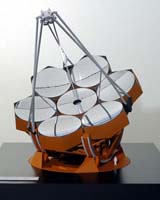
Australia's National University is the latest international partner to join the consortium developing Giant Magellan Telescope, which will be the largest optical instrument in the world.
The GMT is slated for completion in 2016 at a mountaintop site in the desert of northern Chile.
It will comprise seven 8.4-meter primary mirrors arranged in a hexagonal pattern, plus one spare off-axis mirror. The array will create a primary mirror with a diameter of 80 feet (24.5 meters), offering more than 4.5 times the collecting area of any current optical telescope and 10 times the resolution of the Hubble Space Telescope.
Arizona State University's Steward Observatory Mirror Laboratory in Tempe is manufacturing the mirrors. The lab built the 6.5-meter Magellan telescope mirrors for Carnegie's Las Campanas Observatory, and the 8.4-meter Large Binocular Telescope mirrors on Mount Graham in Safford, Ariz.
Steward technicians successfully cast the first off-axis mirror for the GMT last July. They currently are processing the back surface of the mirror and will begin polishing the front surface next year. The existing multiple-mirror Magellan telescope has proven the technology and is considered the best natural imaging telescope on the ground.
The GMT is designed to work in tandem with the future generation of planned ground- and space-based telescopes. Site testing at the Las Campanas Observatory is also underway for the GMT, along with many other aspects of the project.
"The addition of the Australian National University to the GMT consortium is the most recent indication of the momentum that the project is generating," said Wendy Freedman, chair of the GMT board and director of the Carnegie Institution's observatories.
"The GMT represents a new epoch for astronomy," said Richard Meserve, the institution's president. "Now, with a group of nine, the consortium is well on its way to accomplishing its goals," he added.
Other GMT consortium members include the Carnegie Observatories, Harvard University, the Smithsonian Astrophysical Observatory, the universities of Arizona, Michigan, Texas at Austin and Texas A&M, and the Massachusetts Institute of Technology.
