
Immediately after President George Bush's re-election Prime Minister Tony Blair said he expected the president to pursue a more "consensual" foreign policy in his second term. Now the British Labor Party prime minister is engaged in trying to make sure his theory was right.
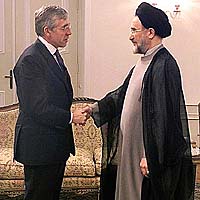
As part of this exercise, British Foreign Secretary Jack Straw is expected in Washington in an attempt to narrow differences between Europe and the Bush administration over how to stop Iran's nuclear program. The Europeans want to negotiate further with the ayatollahs, following Tehran's recent agreement that it will suspend uranium enrichment while trade talks continue.
What the Bush administration wants is not entirely clear. European observers say that understanding U.S. intentions on Iran has not been helped either by Bush's strongly interventionist inaugural address – or by remarks about Iran last week by Vice President Dick Cheney.
In his address, Bush declared that the United States would support democratic movements and institutions throughout the world, "with the ultimate goal of ending tyranny in our world."
The speech caused concern overseas because its lack of specifics suggested more Iraq-type interventions. It came after Cheney said ominously in an interview that Iran was "right at the top of the list" of potential trouble spots.
He said the United States favored a diplomatic solution, but "the Israelis might well decide to act first and let the rest of the world worry about cleaning up the diplomatic mess afterwards." Israeli officials have on more than one occasion denied any such plans.
Blair's unwavering support for Washington in the Iraq war cost him dearly in both popular and party support. On Feb. 26, 2003, the British prime minister faced the largest parliamentary rebellion in over a hundred years. Some 120 members on the Labor benches voted against the government's policy of supporting U.S. military action against Iraq.
With an election looming in the early summer, Blair is trying to reassure the rebellious left wing of the party that Britain will not be dragged into any more armed interventions by the Bush administration.
His hopes of reaping some political benefit from Britain's support of the United States in Iraq are mainly pinned on being able to persuade the Bush administration to get serious about rekindling the Middle East process. Significant progress with the Middle East "road map" would help repair the rift with the British Labor left.
But just as Blair acted out of personal conviction in backing Bush on Iraq, he also seem to genuinely believe that a resolution of the Israeli-Palestinian conflict is crucial to bringing stability to the Arab world, and he is pressing Bush to use American influence in the region, in particular with Israel, to expedite a lasting peace.
The impact on the British elections of progress in the Middle East is one consideration, but there is more, according to analysts in London. In June 2005, Britain assumes the six-month rotating presidency of the European Union, and it is in Blair's interest to demonstrate his credentials as a peacemaker as well as a wartime prime minister.
Every EU country tends to concentrate its presidency on advancing a major issue. The word is that a re-elected Blair would want to make a lasting resolution to the Palestinian-Israeli conflict with coordinated American and EU efforts as the centerpiece.
On the U.S. side, Washington objects to the EU's plan – which Britain supports – to lift the arms embargo against China. The ban on arms sales was imposed in 1989 after the Chinese regime suppressed pro-democracy protests in Beijing's Tiananmen Square, but the Europeans want end it, once certain safeguards are put in place.
British Foreign Secretary Jack Straw admitted in Beijing Monday that there was a divide on the issue between Washington and Brussels. But he added that U.S. and EU officials would have to "manage these differences" in the next few months.
