
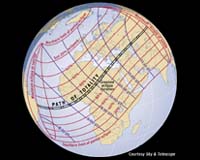
On Wednesday, March 29, 2006, a total eclipse of the Sun will sweep across parts of West and North Africa, Turkey, and Central Asia. The eclipse will be partial across a much wider region, including most of Africa, all of Europe, and much of western and southern Asia.
A solar eclipse happens when the Moon crosses the face of the Sun as seen from your viewpoint on Earth. The March 29th total eclipse starts at sunrise at the tip of Brazil, crosses the Atlantic in the morning, the Sahara Desert at midday, Turkey in the afternoon, and ends at sunset in Central Asia.
Although a partial solar eclipse can't hold a candle to a total one, it's a memorable celestial event in its own right. Can you see a change in the illumination of the landscape around you? A partial eclipse has to be surprisingly deep to alter the light visibly, because our eyes are very good at adjusting to ambient light levels. But when this does happen, the world seems to take on an odd, silvery feel like no other.
Look for crescent-shaped dapplings on the ground where sunlight shines through leaves. In a safely solar-filtered telescope, look for mountain silhouettes on the Moon's dark edge. Look too for a difference between the Moon's complete darkness and the not-so-complete darkness of any sunspots that the edge of the Moon approaches.
Warning: Never look at the bright surface of the Sun without proper eye protection! Examples are special "eclipse glasses" properly designed for the purpose, a #14 rectangular arc-welder's filter, or special astronomers' solar filters. Staring at the bright Sun can burn your retina, leaving a permanent blind spot in the center of your vision. The only reason a partial eclipse poses a special danger is because it can prompt people to look directly at the Sun, something they wouldn't normally do.
Looking while the Sun is totally eclipsed, on the other hand, is safe. At that time, of course, none of the Sun's bright surface is in view.
