
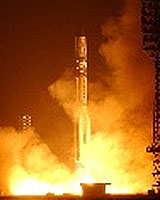
The Americom-15 (AMC-15) satellite of SES Americom, an SES Global company, roared into space onboard a Russian Proton M/Breeze M launch vehicle from the Baikonur Cosmodrome (Kazakhstan) today at 3:23 a.m. Baikonur time (11:23 p.m. CET; 5:23 p.m. Eastern U.S. on October 14th). After 6 hours and 55 minutes, the spacecraft separated from the Breeze M upper stage and was placed into geostationary target orbit (8:18 a.m. St. Petersburg time; 6:18 a.m. CET; 12:18 a.m. Eastern U.S.).
As the first satellite dedicated to Americom2Home, AMC-15 has been optimized to provide both direct-to-home video and broadband services into a single dish. After thorough testing of all on-board systems, AMC-15 will be ready to operate from its intended 105 degrees West orbital position and deliver service to all 50 U.S. states.
Bryan McGuirk, Senior Vice President of Media Services, SES Americom, said, "The AMC-15 spacecraft has a very important mission as the first satellite we have committed to EchoStar Communications. and its DISH Network satellite TV service … this really puts our Americom2Home initiative on the map as a robust platform provider for the U.S. direct-to-home industry. Thanks to both ILS and Lockheed Martin for a job well done; we are looking forward to delivering AMC-15 in peak condition to our customer."
Ted Gavrilis, President, Lockheed Martin Commercial Space Systems, said, "AMC-15 is the eleventh A2100 we have successfully delivered for SES Americom; the third of four in 2004. We are proud of our relationship with Americom, considered one of the most demanding spacecraft operators in the industry, and especially look forward to the activation of AMC-15's Ka-band payload, the first major commercial Ka-band operation in the United States."
Mark Albrecht, ILS President, "I am delighted that Proton's 309th mission was a success, and a success for one of our steadiest customers, SES Americom. The launch of AMC-15 is the eighth by ILS for Americom since we were established in 1995; we have another two satellites for Americom in our 2004 manifest, another Proton and an Atlas 5."
AMC-15 Satellite
Built by Lockheed Martin Commercial Space Systems, AMC-15 was manufactured in their Newtown, Pennsylvania and Sunnyvale, California facilities. The hybrid spacecraft is based on an A2100AX platform.
AMC-15 is expected to reach geosynchronous orbit and its testing orbital location 136 degrees West on October 23rd. At that time, the satellite's solar panels and two communication antennas will be deployed. After thorough testing of all of the on-board systems, AMC-15 will be ready for service in approximately eight weeks.
Launch Summary
AMC-15 was launched by International Launch Services (ILS), the joint venture between Lockheed Martin of the U.S. and Khrunichev and RSC Energia of Russia. The Proton launch vehicle injected the satellite into geosynchronous transfer orbit, using a three-burn Breeze M mission design.
The first three stages of the Proton used a standard ascent trajectory to place the Breeze M fourth stage, with the satellite, into a suborbital trajectory, from which the Breeze M then placed itself and the spacecraft into a circular parking orbit.
The satellite was propelled to a transfer orbit; it reached its final target by the third and final burn of the Breeze M at 7220 km, inclined at 18.6 degrees where it was separated from the Breeze M. Preliminary signal acquisition from the separated AMC-15 was achieved at 10.49 local time (8.49 a.m. St. Petersburg time; 6:49 a.m. CET; 12:49 a.m. Eastern U.S.) (7 hours and 20 minutes after liftoff).
Next will be a series of liquid apogee engine burns on the spacecraft to raise perigee, lower inclination and circularize the orbit at the geostationary altitude of 36,000 km (22,300 miles).
