
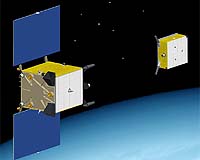
Alcatel Alenia Space today announced that it will develop and supply the S-Band Formation Flying Radio Frequency (FFRF) sensor for the PRISMA mission. PRISMA primary goal is to perform guidance, navigation and control demonstrations as well as in-flight validation of sensor technologies for future missions in which rendezvous and formation flying are a prerequisite, such as Darwin.
PRISMA consists in two spacecrafts, one highly manoeuvrable (Main) and another one (Target) passive, that should be launched in 2009. Both satellites will fly together in the same orbit, the Main satellite moving towards and away from the smaller and lighter Target, which will follow its initial trajectory.
Alcatel Alenia Space's French and Spanish entities will design, develop, manufacture, test and supply the FFRF sensor, under the frame of the bilateral Earth science missions agreement signed between CNES (the French space agency) and CDTI (the Spanish space agency).
The FFRF sensor, which will comprise 2 FFRF terminals, 2 sets of antennas and 2 associated test benches, will provide real-time relative positioning and inter-vehicle communication services with a dynamic range between 3m to 30km and a positioning accuracy of 1cm. It will be used for ESA's and CNES' next generation formation flying missions.
PRISMA (Prototype Research Instruments and Space Mission technology Advancement) is an eight months flight mission funded by the Swedish National Space Board (SNSB) – with Swedish Space Corporation (SSC) as prime contractor – developed in cooperation with the German Aerospace Center (DLR), the Danish Technical University (DTU) and the French Space Agency (CNES).
