
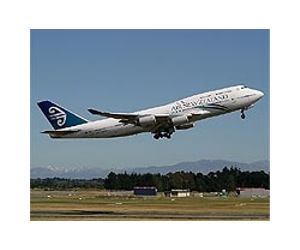
Air New Zealand warned Tuesday the Christchurch and Japanese disasters had dashed its second-half profit prospects, sending shares in the airline plummeting almost eight percent.
The company said it was already facing difficulties after last month's Christchurch earthquake, which had been compounded by the unfolding Japanese tragedy.
"The financial impact of the Christchurch earthquake is more severe than expected," it said in a statement.
"Further, the recent tragic events in Japan will also impact revenue in that important market."
The airline said based on current fuel prices and demand trends, it "does not expect to be profitable in the second half year and full-year normalised earnings are expected to fall below NZ$100 million ($74 million US)."
Shares in the New Zealand flag carrier dipped 7.6 percent to NZ$1.10 after the announcement, in an overall market down 0.04 percent.
Air New Zealand, which is 76.5 percent state owned, announced a 75 percent jump in interim net profit of NZ$98 million for the six months to December on February 24.
At the time, it forecast a profitable second half, subject to volatile aviation fuel prices.
The airline lifted air fares last month to cover the rising cost of jet fuel and has announced plans to increase ticket prices again from Friday for the same reason.
earlier related report
US backs Japan's economy despite disaster
Washington (AFP) March 14, 2011 –
The United States offered a firm endorsement of Japan's economy Monday, saying it had "full confidence" its ally would parry the financial aftershocks of its earthquake and tsunami disaster.
Despite fears over the tragedy's impact on the fragile global economic recovery, and sell-offs on global stock markets, the White House said it believed Japan was sufficiently resilient to ride out the crisis.
"These are still early days, but that we remain confident that Japan and, therefore, the world can deal with this crisis and respond and rebuild in a way that is good for Japan and good for the world," White House spokesman Jay Carney said.
"We have that confidence and we therefore believe that the resiliency of the Japanese people, the resiliency of the Japanese economy are very important factors in the capacity of Japan to handle this."
Carney spoke up after Japanese stocks saw their biggest fall for two years, plunging 6.18 percent Monday and the central bank pumped a record amount of money into markets shaken by the quake, a tsunami and a nuclear emergency.
US stocks took direction from Tokyo. The Dow Jones Industrial Average finished 51.24 points lower (0.43 percent) at 11,993.16.
The tech-rich Nasdaq Composite dropped 14.64 points (0.54 percent) to 2,700.97 and the S&P 500-stock index, a broader measure of the markets, shed 7.89 points (0.60 percent) at 1,296.39.
European finance ministers meeting in Brussels for talks focused on plans to defend the euro from future debt crises were also discussing the impact of events in Japan.
The two-day meeting of the world's 20 industrialized and emerging economies will allow ministers to closely examine possible reactions to events in Japan.
Noting that Japan is the world's third biggest economy after the United States and China, Spanish Finance Minister Elena Salgado said the EU "must be attentive."
"Japan also has an impact on the (world) economy," she told reporters.
Share This Article With Planet Earth
