
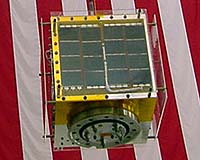
Cadets will watch their engineering efforts blast into space in a launch televised live to the Air Force Academy.
The cadet-built satellite FalconSAT-2 is scheduled for launch on Nov. 25 at 2 p.m. MST from the Ronald Reagan Ballistic Missile Test Site on Kwajalien Atoll, in the Marshall Islands.
Once the satellite is released into orbit by the commercial rocket, cadets will then take the controls via the Academy's ground control station and gather scientific data.
This satellite is a product of the Academy's Space Systems Research Center.
The center runs a multi-disciplinary two-semester astronautical engineering course where cadets put theory into practice by designing and constructing a small satellite for Department of Defense research programs.
The satellite's research mission is to measure space plasma phenomena in the lower ionosphere, which can adversely affect space-based communications, including the Global Positioning System and other civil and military communications.
FalconSAT-2 was originally slated for launched aboard a space shuttle in early 2003. But the Columbia disaster put that launch on hold until recently.
Meanwhile, the Space Systems Research Center's cadets are busy constructing the flight model of the center's fourth satellite, FalconSAT-3.
That satellite has a launch date of September, 2006. Cadets are also beginning conceptual design for a fifth Air Force Academy satellite during this academic year.
Two previous small satellites – FalconGold and FalconSAT-1 – were launched in 1997 and 2000 on research missions.
The Air Force Academy is one of only two educational institutions where undergraduates can design and construct small satellites and have their work launched into space for real-world research missions.
