
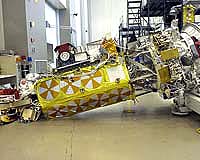
NOAA, NASA and Lockheed Martin announced today that they have reached an agreement that a NOAA satellite, damaged during a fall while it was being constructed, would be rebuilt to launch in December 2007.
As part of this agreement, Lockheed Martin agreed to provide corporate funds toward the rebuild effort. NOAA, the National Oceanic and Atmospheric Administration, is an agency of the U.S. Department of Commerce.
"This agreement ensures steady access to NOAA satellite data that feeds our prediction and warning capability for weather and climate," said Gregory Withee, assistant administrator for NOAA's Satellite and Information.
When launched, the NOAA satellite, named N-Prime, will carry a suite of instruments that will provide critical global information for numerical weather and climate predictions.
The satellite will also provide imagery to NOAA's National Weather Service, providing valuable information on tropical storms, seasonal temperatures, space and solar activity, and data important for the marine and aviation industry.
The NOAA N-Prime will also provide operational back up for Department of Defense military operations and contribute to international satellite-aided search and rescue missions.
On September 6, 2003, while Lockheed Martin was performing work on NOAA N-Prime, the satellite was dropped. A team led by NOAA, with participation by NASA and the DoD, developed recovery options and deliberated on the recommendations.
Today, NOAA also announced stricter safety measures that all satellite contractors must practice in their respective facilities to prevent a repeat accident. NOAA and NASA also have established improved oversight of satellite contractors.
NOAA N-Prime is the last of a fleet of NOAA weather satellites, which have served the nation since 1978. NOAA's next generation of polar satellites ¿ the National Polar-Orbiting Operational Environmental Satellite System, a joint program with DoD and NASA ¿ will begin launching in early 2010.
