
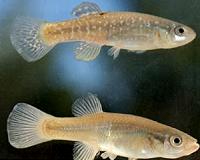
New research suggests no vertebrate species matures as quickly as Africa's turquoise killifish.
The tiny fish persist for most of the year as diapausing embryos buried in savannah sediments. Like dormant plant seeds, the embryos suspend their development until rains arrive.
When rains finally do arrive and water pools in small depressions, the fish are on the clock. They must hatch, grow and reproduce before the pools dry up.
When scientists surveyed turquoise killifish, Nothobranchius furzeri, populations in southern Mozambique, they found the tiny fish hatch, grow and begin reproducing in just two weeks.
"We guessed that some populations of this species could achieve very rapid growth and sexual maturation under particular conditions," Martin Reichard, researcher at the Czech Academy of Sciences' Institute of Vertebrate Biology, said in a news release. "But we have found that this rapid maturation is the norm rather than a rare exception."
Scientists shared their findings this week in the journal Current Biology.
Though record maturation speed is the norm, the survey's findings confirmed the species' maturation process is flexible. Previous lab tests have shown killifish can stretch the maturation process out to 10 weeks when conditions are optimal.
By comparing the age of fish in different pools, scientists determined the fish hatched three days after local depressions filled with rainwater. Both males and females showed evidence of full sexual maturation within 14 or 15 days.
Scientists hope followup studies will reveal new details about the unique maturation process. Researchers hope further analysis will help them understand why male killifish have shorter lifespans than females.
