
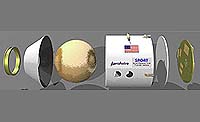
AeroAstro has won a $3 million contract to build the first Small Payload ORbit Transfer (SPORT) vehicle for the Malaysian company, ATSB. SPORT will be sandwiched between an Ariane V launch vehicle piggyback structure and the ATSB NEqO satellite and will carry NEqO from its release in Geosynchronous Transfer Orbit (GTO) to its final destination in Low Equatorial Orbit (LEqO).
By allowing use of the Ariane Structure Auxiliary Payload (ASAP) for spacecraft designed for LEqO orbits, the SPORT module reduces the total cost of dedicated access to space for microspacecraft from about $22 million to under $10 million.
SPORT utilizes AeroAstro's highly-tested Bitsy ™ core electronics module as its basic building block and operates autonomously with its own processing, communications, chemical propulsion and aerobraking sy1stems. It may also be configured to provide avionics support to its passenger payload, if required. The Bitsy module will be deployed in late 2001 from STS-108 in a NASA-funded experiment.
Dr. Rick Fleeter, President and CEO of AeroAstro, said, "The cost of transportation to space has been a bottleneck, restricting the applications and growth of the microsatellite marketplace. SPORT builds directly upon our development of the Bitsy spacecraft core to provide frequent, reliable, flexible space access at prices at or below the price of the spacecraft itself. SPORT represents a completely new pipeline to space for micro and nanosatellites."
The SPORT system follows AeroAstro's modular "Personal Satellite ™" design standards and may be used for a variety of payload sizes and weights as well as different orbit transfers.
ATSB will be providing several SPORT subsystems to AeroAstro and will be partnering with them on SPORT marketing and sales.
In related matters, AeroAstro has a cooperative agreement with Arianespace of Evry, France, for development of a SPORT system compatible with the Ariane V piggyback system, and the company is also working with the U.S. National Reconnaissance Office to expand U.S. piggyback capabilities.
AeroAstro, a pioneer of micro and nanospacecraft applications in science, remote sensing and communications, led the trend towards high technology in miniature satellites–now the industry standard. It has designed and launched the highly successful ALEXIS satellite currently in its seventh year operating on-orbit, and also designed the HETE satellite used by MIT as the basis for the successful launch of HETE-2 this year.
