
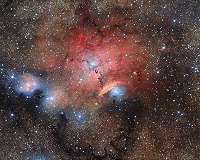
An important scientific discovery was made by the Aristotle University research team dealing with plasma astrophysics and high energy astrophysics, composed of the professor at the Physics Department Loukas Vlahos (http://www.astro.auth.gr/~vlahos), the researcher Dr. Heinz Isliker and the PhD candidate Theophilos Pisokas.
In particular, they propose that the heating and acceleration of particles, normally associated with explosive phenomena or astrophysical flows in space, are due to their interaction with turbulent magnetic and electric fields that are caused by astrophysical explosions.
The universe is a very efficient charged particle accelerator. Most explosive phenomena in space (supernova, flares, and many others) are associated with high energy photons (X-rays and gamma rays), and cosmic rays and measurements from satellites crossing the heliosphere witness the presence of cosmic accelerators.
A new mechanism for particle acceleration has been suggested based on the abrupt release of magnetic energy that we encounter in unstable ionized gases (plasmas) and which is generated by explosive phenomena or astrophysical flows.
The new mechanism combines large amplitude magnetic disturbances and powerful electric fields concentrated in small structures within the ionized gases.
Magnetic disturbances interact stochastically with the charged particles and heat them while strong electric fields accelerate electric charges, mainly contributing to the formation of a high energy tail in the energy distribution. The synergy of stochastic and systematic acceleration caused by the mixture of magnetic disturbances and electric fields heats and accelerates the particles.
The final energy distribution of the accelerated particles in the environment of turbulent electromagnetic fields is in agreement with the observations. Professor Loukas Vlahos argued that "turbulent strong electromagnetic fields are a very common state in space plasmas, when driven by astrophysical bursts or flows, and they combine two mechanisms for accelerating charged particles, originally proposed by the distinguished Italian astrophysicist Enrico Fermi in the early 1950s. We believe that strong turbulence is a new and very efficient mechanism for accelerating and heating astrophysical plasmas.
An interesting part of this study is that the synergy of stochastic and systematic acceleration in turbulent electromagnetic fields has many similarities with astrophysical shock waves, the best known acceleration mechanism till now in astrophysics, since large amplitude magnetic disturbances trap and force a fraction of the particles to return to the strong electric fields, which are randomly distributed within the unstable environment of astrophysical explosions or flows, thereby accelerating the particles systematically to very large energies."
How massive can neutron stars be
Since their discovery in the 1960s, scientists have sought to answer an important question: How massive can neutron stars actually become? By contrast to black holes, these stars cannot gain in mass arbitrarily; past a certain limit there is no physical force in nature that can counter their enormous gravitational force. For the first time, astrophysicists at Goethe University Frankfurt have suc … read more
