
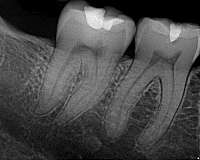
Researchers have discovered ancient dental fillings in northern Italy, the world's oldest. The fillings were found inside a pair of 13,000-year-old front teeth. They were made of bitumen, a semi-solid form of petroleum.
Each of the two teeth feature large cavities. Marking on the walls of the holes suggest the cavities were hollowed out and enlarged by stone tools. While analyzing the holes, scientists found residues of bitumen. Researchers also found plant fibers and hair trapped in the asphalt.
The fillings likely served the same purpose they do today, to reduce pain and keep food out of the cavities. Archaeologists estimate the asphalt and plant matter filler was chosen for its antiseptic qualities — used to prevent infection.
"It is quite unusual, not something you see in normal teeth," Stephano Benazzi, an archaeologist at the University of Bologna, told New Scientist.
Researchers described the discovery in the American Journal of Physical Anthropology.
Archaeologists have previously discovered the use of beeswax as filling inside a 6500-year-old tooth recovered in Slovenia.
New bioactive foam could replace lost skull bone
Washington (UPI) Apr 7, 2017 –
Researchers at the Rensselaer Polytechnic Institute in Connecticut are creating a new moldable, bioactive foam that could be used to replace skull bone lost during injuries and surgeries.
The foam becomes malleable when soaked in warm saline and hardens once fitted into place. The material wouldn't serve as a permanent replacement, but instead act as scaffolding on which new bone could grow.
The foam includes pores with a coating designed to attract new bone cells. As new bone regenerates, the foam disintegrates.
Currently, surgeons typically use bone grafts from the patient's hip to fill-in cranio-maxillofacial gaps.
"This is like trying to fill in a missing puzzle piece with the wrong piece," Melissa Grunlan, an associate professor at Texas A&M University, said in a news release. "These bone defects can cause tremendous functional problems and aesthetic issues for individuals, so it was recognized that a better treatment would make a big impact."
Using grant funding from the National Institutes of Health, Grunlan and her colleagues are currently testing different iterations of the foam.
"We want to find the ideal formulation that maintains the amazing shape memory properties of the foam while providing the optimal environment for stimulating new bone formation," said Mariah Hahn, a Rensselaer professor of biomedical engineering.
The foam has already proven to be biocompatible in test using animal models. Currently, Hahn is trying to better understand why different foam iterations encourage bone cell proliferation better than others.
"A moldable bone-promoting scaffold could have broad use if it's successful," concluded Hahn. "It takes advantages of the body's own healing ability, and it's a low-cost, 'off the shelf' solution that would not need to be pre-tailored to the individual defect."
As the richer get richer, carbon emissions rise, new research shows
Inequality is positively correlated with carbon emissions, new research shows.
According to analysis by Boston College researchers, states in which wealth is more concentrated at the top burned more carbon between 1997 and 2012.
Scientists calculated the additional carbon burned as the top 10 percent of each state's wealthiest citizens accrue another 1 percent of the economic pie … read more
