
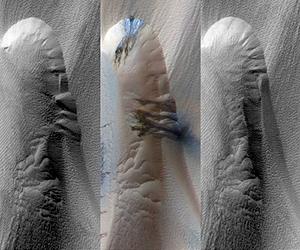
In the sand dunes in the north polar sand sea of Mars, sand avalanches that appear as wedge-shaped alcoves can be seen above fan-shaped deposits. The avalanches, which are typically several meters across, are currently actively forming, with new alcoves showing up in recent images taken in consecutive Mars years.
Some scientists have proposed that these sand avalanches occur when frozen carbon dioxide (CO2) sublimates, triggering the downslope flow (mass wasting) of sand grains and rock that had been lying on top of the CO2 frost. However, Horgan and Bell now suggest that these alcoves may actually have been formed by wind-driven movement of sand, not by CO2 sublimation.
The authors' close examination of high-resolution images from the Mars Reconnaissance Orbiter High Resolution Imaging Science Experiment revealed that the alcoves were present under CO2 frost. This indicates that while sublimating CO2 frost may have caused additional mass wasting that steepened the alcoves, CO2 sublimation was not the primary cause of their formation.
In addition, the authors find that the orientation of the alcoves and the direction of recent prevailing winds support their hypothesis that wind drove the formation of these features. Furthermore, the alcoves are morphologically similar to smaller alcoves observed on dunes on Earth, which are known to have been created through wind-driven processes.
The new result that wind and saltation are the driving factors behind the avalanches is consistent with several recent studies using high-resolution imagery that have shown that most sand dunes on Mars today are active and migrating at measurable rates.
